What Mid-Market Private Equity Firms Ask a ₹50 to 500 Crore Promoter in the First 90 Days
Mid-Market Private Equity: The First 90 Days for a Promoter

A mid-market private equity fund rarely says no at the first meeting. It says no later and quietly, after a data request came back late or a margin story failed to reconcile. If you own a ₹50 to 500 crore business in Kochi, Bengaluru or Chennai, the first 90 days decide whether your conversation ever reaches an investment committee. This guide walks that window in order: screening, teaser and data request, management meeting, committee and term sheet. It is written from the promoter's chair and draws on how we help promoters raise PE capital.
Key Takeaways
- Average PE and VC tickets fell to US$23 million in 2025 as volumes rose, so smaller cheques are in fashion.
- Most funds decide from your numbers before the first meeting, so reconcile your accounts before you make a single call.
- Five questions dominate the management meeting: repeatable growth, customer concentration, use of funds, second line and exit.
- A term sheet is mostly non-binding, but exclusivity binds you, so negotiate its length before you sign anything.
Where Mid-Market PE Capital in India Actually Sits
Start with the money, not the address. Bain and IVCA's 2026 India report puts 2025 PE and VC investment at about US$36 billion, down roughly 17%. Deal volumes rose about 10%, while average deal size fell roughly 25%. Bain reads this as a structural shift towards smaller cheques and lower stakes, with particular interest in mid-sized assets.
That shift suits a promoter of your size. Asia Asset's report on the Bain data gives an average ticket of US$23 million in 2025, against about US$30 million in 2024, across roughly 1,700 deals. Venture rounds sit inside that average. Even so, the direction is clear: investors are writing smaller cheques, and more of them.
Now the address. Many funds that write cheques at this scale run their deal teams from Mumbai, including the two mid-market funds in the table below. No public source measures the exact share, so treat this as a working observation. For a South Indian promoter, the practical point is simple. You will probably pitch to someone in another city, whether or not you ever board a flight.
Fund profiles give a sense of scale, though they date quickly. The table sets two published profiles beside the market average. One fund reported cheques of up to ₹100 crore in 2022. The other reported US$15 to 50 million for 20 to 25% stakes in 2018. Ask every fund for its current band, because these numbers will have moved.
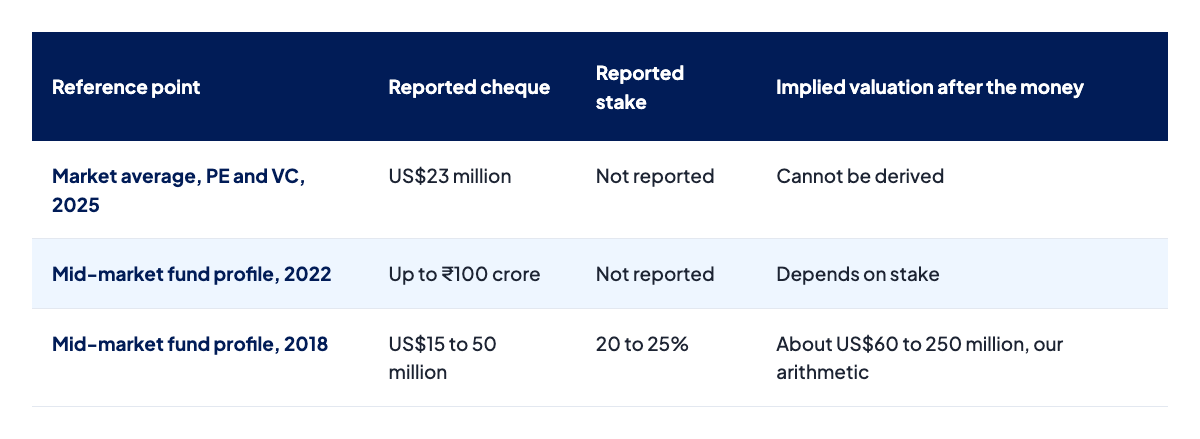
Here is why the band matters, as an illustrative example. A ₹100 crore cheque for a 25% stake implies a ₹400 crore valuation after the money. A promoter whose business is worth ₹120 crore cannot absorb that cheque without giving up control. So your first job is to find mid-market private equity funds whose smallest cheque fits your business, not whose brand you recognise.
What Private Equity Companies in Mumbai Screen For Before the First Meeting
Before anyone meets you, a junior team member reads whatever is public: your website, your filed accounts, press and customer references. Most private equity companies in Mumbai that work this size band will run this desk check long before a plant visit. If you run a second-generation spice export house in Thrissur, assume they have already seen your filed revenue and margins. Your first call should begin there.
The first screen is ticket fit. Can the fund put in its minimum cheque at a stake that suits both sides? The second is sector thesis. Funds often have a short list of themes, and a strong business outside those themes may still get a polite pass. That pass says little about your company. It usually says the fund has no one to cover your sector.
The third screen is the split between primary and secondary money. Primary capital goes into the company and funds growth. Secondary capital goes to the promoter as liquidity. Funds generally prefer most of the money to work inside the business. If your real aim is to take money off the table, say so early, because a late surprise on this point ends conversations faster than a weak quarter.
The fourth screen is distance, and here a regional promoter must do extra work. An analyst in another city may not know why your Kottayam distributor network took a generation to build, or why a Chennai plant's local labour record matters. They cannot price what they cannot see. Put your regional advantage in plain numbers: tenure of dealers, repeat order rates and the cost of replicating your footprint.
Then come the quiet filters. High customer concentration, related-party transactions, family members on the payroll without clear roles and unexplained cash sales will all slow a file. So will unresolved statutory notices, and our note on non-compliance as a red flag explains why. None of these is fatal alone. Together, they tell the fund that its diligence will be long and expensive.
Knowing how these desks fill their pipelines also helps. Deal flow comes through advisers, bankers, portfolio founders and lawyers as well as inbound mail. Our explainer on how PE houses access investment opportunities covers those routes. Private equity companies in Mumbai see more teasers than any desk can read closely, so a warm, relevant introduction to the right partner beats a mass mailing.
Days 1 to 30: The Teaser, NDA and First Data Request
A note on the calendar first. Funds do not publish a standard timetable, and we use 90 days as a planning frame rather than a rule. Many processes run longer. Still, the order of events is stable, and a promoter who prepares for this sequence loses far less time. The infographic below sets out that order, from first screen to signed term sheet.
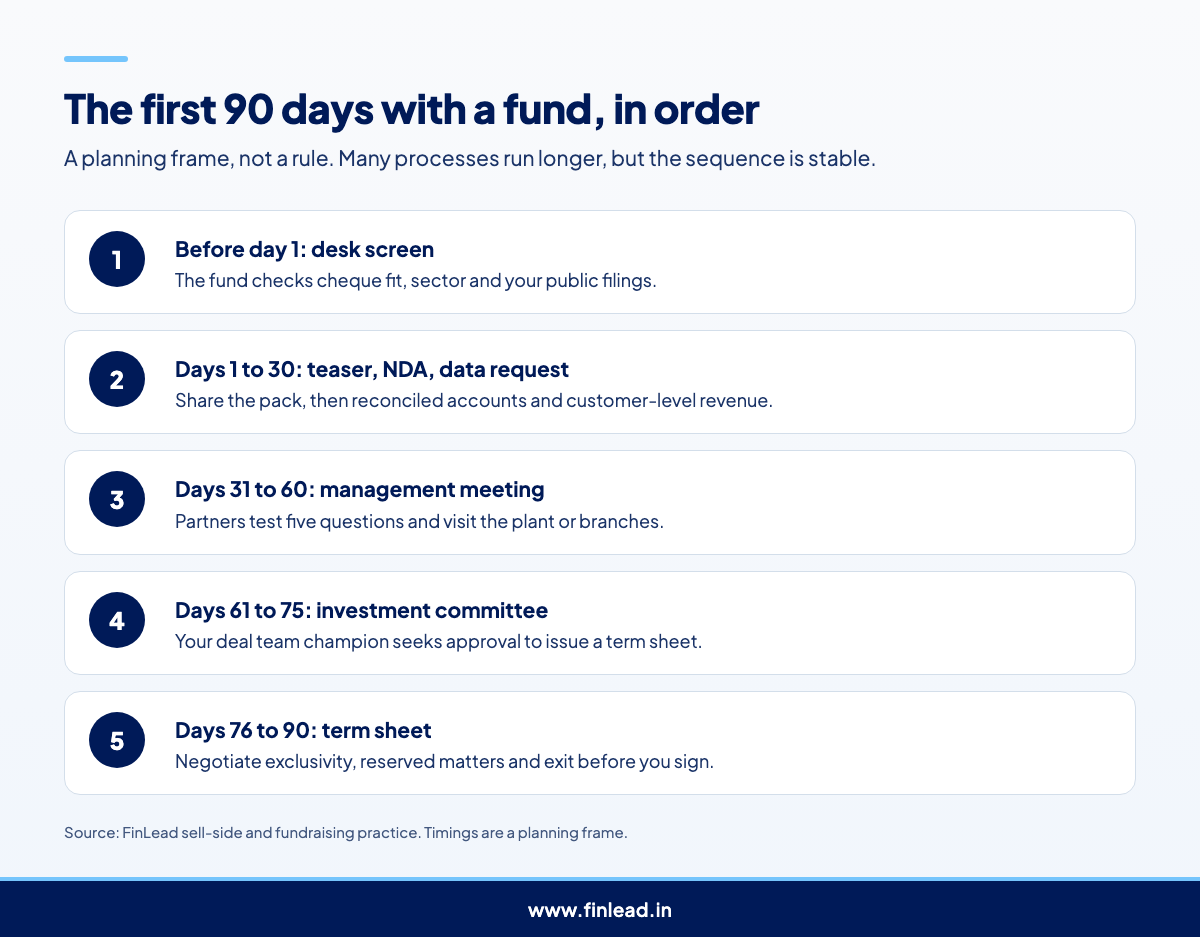
The teaser comes first. It is a short, usually anonymous note describing the business, its size and the opportunity. If the fund is interested, you sign an NDA and then share the fuller investor pack. Our investor pack framework sets out what belongs in it. Read the NDA properly, especially any clause that limits a fund's dealings with your competitors, because many funds will not accept a strict one.
The first data request usually follows within days of the pack. Expect three years of audited accounts, monthly management accounts for the current year, revenue by customer and product, a headcount summary and a shareholding chart. A finance head in a Thrissur family firm may need weeks to rebuild customer-level revenue from invoices. Find that out now, not when the request lands.
Speed is part of the test. A fund cannot audit your culture in the first month, so it reads your response time as a signal of how the company runs. Answer in one consolidated file, label versions and explain every variance before someone asks. Assign one person to own the data room. Family firms often scatter this work, and scattered answers produce contradictory numbers.
Reconcile before you send anything. Revenue in your teaser, your audited accounts and your GST returns should tell one story, with any differences explained in a note. Promoters often see this step as clerical. In practice, it is where a fund first decides whether your numbers deserve trust.
Days 31 to 60: The Management Meeting and the Five Questions Every Fund Asks
By now the fund likes the file enough to spend partner time on you. Five questions dominate these meetings, whatever the sector. The first is whether growth can repeat without you. If the top ten accounts follow your personal phone number, the fund sees a key-person risk and a discount. Show them which relationships already sit with your sales head and your second line.
The second question is who holds your customers. Fund teams look at the share of your top five customers, contract length and how renewals happen. The third is what the money will do. Generic answers such as "expansion" fail here. A Bengaluru precision-parts maker should name the machine, the customer programme it serves, the payback and the month the capacity comes on stream.
The fourth question is who runs the business when you step away. Mid-market private equity investors back teams, and a family firm with one decision-maker worries them. Explain the second line honestly, including the hires you still need. Our guide to how traditional Indian businesses can use PE to fund expansion covers the governance gap that older family firms typically close first.
The fifth question is how the fund gets out. Every fund answers to its own investors and must plan an exit from the first day. Promoters often find this question uncomfortable, but it deserves a prepared reply. Discuss a promoter buyback, a sale to a strategic buyer, a later fund or a listing. Our note on how funds plan their exits sets out each route.
Expect the plant or branch visit in this window. The team will talk to your managers, and sometimes to customers, with your consent. Brief your managers on the process, not on what to say. Funds notice rehearsed answers quickly. They also notice a promoter who answers every question put to a colleague, so let your finance and operations heads speak.
Days 61 to 90: Investment Committee, Term Sheet and What Is Negotiable
The deal team now takes your company to its investment committee, usually first for approval to issue a term sheet and later for final approval after diligence. You will not attend. Your deal team champion presents your numbers and must defend them against sceptical colleagues. So give that person what they need: clean data, a clear story and honest answers on your weak spots.
A term sheet then arrives, and most of it does not bind anyone yet. As a LexOrbis note on Indian term sheets explains, it is largely non-binding, with exceptions such as confidentiality, exclusivity, governing law and dispute resolution. The same note suggests a company limit exclusivity to two or three months. Exclusivity deserves your attention because it switches off your alternatives while the fund finishes diligence.
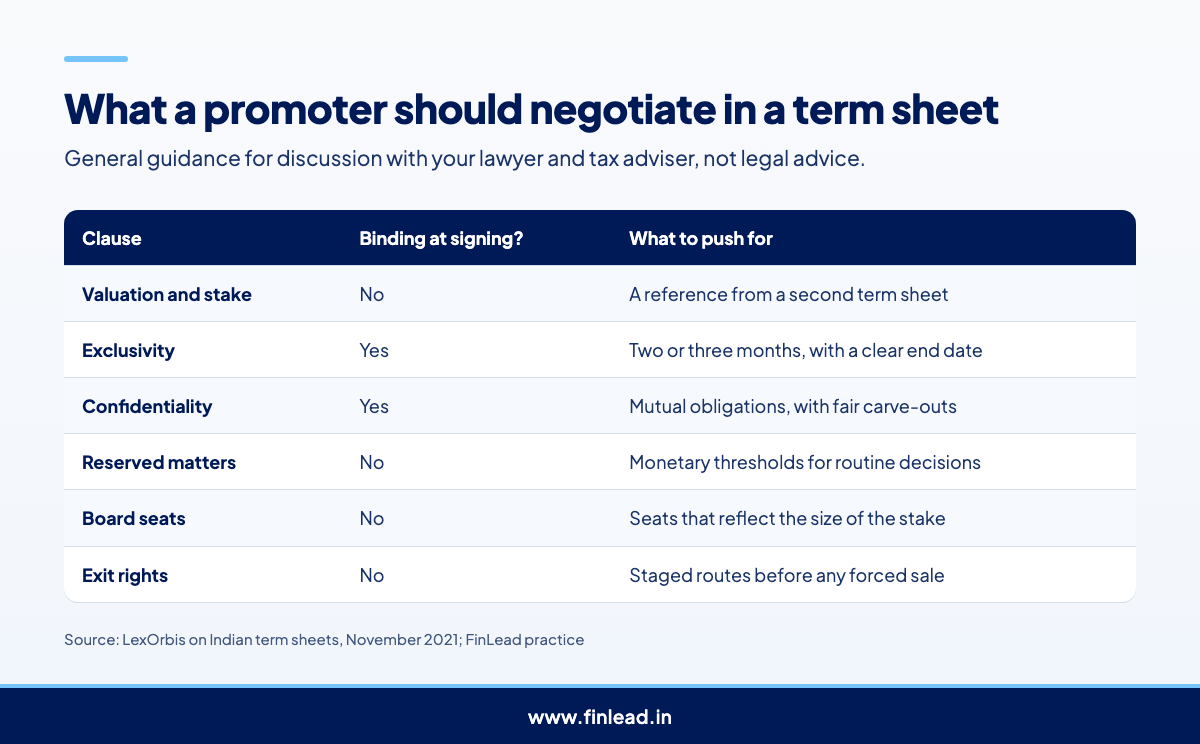
Almost everything else is negotiable, though not all of it to the same degree. Valuation attracts the most attention, yet the clauses around it often matter as much. Reserved matters decide what you can do without the investor's approval. Promoter lock-ins, anti-dilution, drag-along and information rights shape your freedom for years. Our explainer on deal structuring shows how structure can move real value.
Choose your battles by how they affect daily control. A long reserved matters list can make you seek permission for routine hiring or capital expenditure, so negotiate thresholds rather than the principle. An exit clause that forces a sale after a fixed period can matter even more. A family weighing this against succession should also read how PE compares with family succession before signing.
Take a lawyer and a tax adviser into this stage. Enforceability of investor rights, foreign exchange pricing rules and tax on any secondary sale are questions for your counsel, not for a blog. What you should bring is clarity on your own lines. Decide in advance what control you will not trade, and write it down before the first draft reaches your inbox.
How an Adviser Changes the Outcome
An adviser cannot fix a weak business, and you should distrust anyone who says otherwise. What a good one changes is the sequence. They match you to funds by cheque band and sector, which cuts wasted meetings. They rebuild your numbers before a fund sees them. They also run several conversations at once, so no single fund sets your timetable or your price.
Parallel conversations matter most at the term sheet stage. A promoter talking to one fund negotiates against that fund's own view of value. A promoter with two serious term sheets has a market reference. An adviser also absorbs routine friction, so you can run your company while diligence runs. Trading often slips during a raise, and a fund will notice.
At FinLead, we work as an adviser on this process, and our growth-capital mandates start with whether you should raise at all. Our closed transaction record lists mergers, acquisitions, private equity and early-stage rounds. Ask any adviser you meet for the same disclosure, and ask who will personally run your file, how many mandates they carry and which funds they would approach first.
Conclusion
The first 90 days with a mid-market private equity fund reward preparation far more than polish. Reconcile your numbers before the teaser goes out, and pick funds by cheque band and sector, not brand. Prepare honest answers to the five questions, and negotiate exclusivity and reserved matters as carefully as valuation. If you run a ₹50 to 500 crore business in Kerala, Bengaluru or Chennai and want a frank view of your readiness, book a confidential conversation with us. We will tell you what a fund is likely to ask, and whether this is the right year to raise.
Frequently Asked Questions
What does a mid-market private equity fund look for first?
It looks for cheque fit, sector fit and clean numbers. Before any meeting, a junior team member reviews your public filings, your website and your margins. If your business falls below the fund's minimum cheque, the conversation usually ends there, however strong it is.
How long does a private equity deal take to close in India?
No standard timetable exists, and we use 90 days only as a planning frame to reach a term sheet. Diligence and definitive agreements then follow. Our note on how long deals take to close gives a fuller picture.
Do I need to travel to Mumbai to raise money from private equity firms there?
Not at the start. Early calls and data requests can happen remotely, and funds usually come to you for plant visits. Budget for a few partner meetings in person, but do not let geography stop you from approaching a fund that fits.
What documents should I prepare before approaching a fund?
Prepare three years of audited accounts, current monthly management accounts, revenue by customer and product, a shareholding chart and a one-page summary of your growth plan. Reconcile these documents with your GST returns first, and explain every variance in a short written note.
Is a private equity term sheet legally binding?
Mostly not. A term sheet is generally non-binding, except for provisions such as confidentiality, exclusivity, governing law and dispute resolution. Those clauses can bind you from the day you sign, so ask your lawyer to review them before you return the document.
Can I keep control after raising private equity?
Yes, many deals are minority investments, but control has more than one form. Reserved matters, board seats and exit clauses can limit your freedom even at a low stake. See our write-up on PE for family businesses in India for more.
What are the five questions every fund asks a promoter?
Can growth repeat without you? Who holds your customers? What exactly will the money do? Who runs the business when you step away? How does the fund eventually exit? Prepared, honest answers to these five questions carry more weight than any polished presentation.
Should I take primary or secondary money from a fund?
Funds generally prefer most of the money to go into the company as primary capital. Secondary sales give the promoter liquidity, and a modest amount is often acceptable. State your intention early, and ask your tax adviser how each option affects you.
Why would a fund reject a profitable company?
Profit alone is not enough. A fund may pass because your business falls outside its cheque band or sector themes, or because concentration, related-party dealings or compliance gaps would make diligence long and costly. A polite pass often says little about your company.