Private Equity for Family Businesses in India: Raising Growth Capital Without Losing Control
Private Equity for Family Businesses in India: Growth Capital

India's family businesses form the backbone of the private sector. From manufacturing and trading dynasties to first-generation growth companies, family-owned enterprises control a significant share of India's GDP. Yet many family business founders hesitate when it comes to private equity family business India funding, fearing loss of control, unwanted interference, or dilution of the family's hard-built legacy.
This guide addresses those concerns directly. It explains how PE investment actually works in a family business context, what founders can protect and what they must give, and how to structure a transaction that accelerates growth without surrendering the things that matter most.
Key Takeaways
- PE investors in Indian family businesses typically take 25 to 40 percent minority stakes, leaving majority control firmly with the founder family.
- Governance, not ownership, is where PE investors focus. Understanding and negotiating governance terms early is the key to a founder-friendly transaction.
- Engaging a [PE advisory firm](https://www.finlead.in/pe-advisory/) ensures family businesses get the capital they need on terms that protect their legacy and operational autonomy.
Why Family Businesses in India Are Turning to PE
Indian family businesses face a common growth paradox: the business has reached a scale where organic reinvestment is too slow to capture the full market opportunity, but bank debt alone cannot fund the capital-intensive expansion required. PE investment resolves this paradox. It provides growth capital without the repayment burden of debt, brings strategic support and network access alongside money, and accelerates the business toward a scale that creates lasting value for the family.
The appetite of PE funds for Indian family businesses has grown significantly over the past decade. Funds have recognised that family-owned enterprises often have unique market advantages, loyal customer relationships, proprietary supply chains, and embedded operational knowledge that took decades to build. These advantages, when combined with professional governance and fresh capital, create compelling investment returns.
Several Indian family businesses have used PE capital to transform from regional players into national leaders. The pattern is consistent: PE brings capital, governance discipline, and strategic networks; the family brings domain expertise, customer trust, and operational depth. When the partnership is structured correctly, both parties win.
What Family Business Founders Fear About PE
The most common concern among family business founders is loss of control. This fear is understandable but often overstated. PE investors are not looking to run your business. They are looking to grow it alongside you. In a typical growth-stage PE transaction, the investor takes a 25 to 40 percent minority stake. The founder family retains majority ownership and, in almost all cases, operational control.
Control provisions in a PE transaction relate to governance, not day-to-day management. PE investors will require a board seat and approval rights for major decisions: raising additional debt above a threshold, selling significant assets, making large acquisitions, or changing the business's strategic direction. These provisions protect the investor's capital without interfering with how the business is run on a daily basis.
A second concern is that PE investors will push for a quick exit that forces the family to sell the business they have spent generations building. Exit timelines are negotiated and documented in the shareholders' agreement. Most growth PE transactions have a 4 to 7 year exit horizon. The exit route is typically a strategic sale to a larger business, a secondary sale to another PE fund, or an IPO that allows the family to retain a listed holding while the PE investor exits. The family does not have to sell the business for a PE investor to exit profitably.
What Founders Can Protect in a PE Transaction
Founders can and should negotiate protections that preserve the aspects of the business they value most. Operational control can be preserved by ensuring that board resolutions require a supermajority for strategic decisions, while routine management decisions are left entirely to the management team led by the family.
Brand and legacy protections can be documented in the shareholders' agreement: provisions that prevent the investor from changing the company name, selling the brand, or restructuring the business in ways that change its fundamental character without family consent. Anti-dilution protections ensure that the family's stake is not involuntarily diluted in future rounds without their agreement. A credible M&A advisory team will ensure these protections are properly documented and enforced.
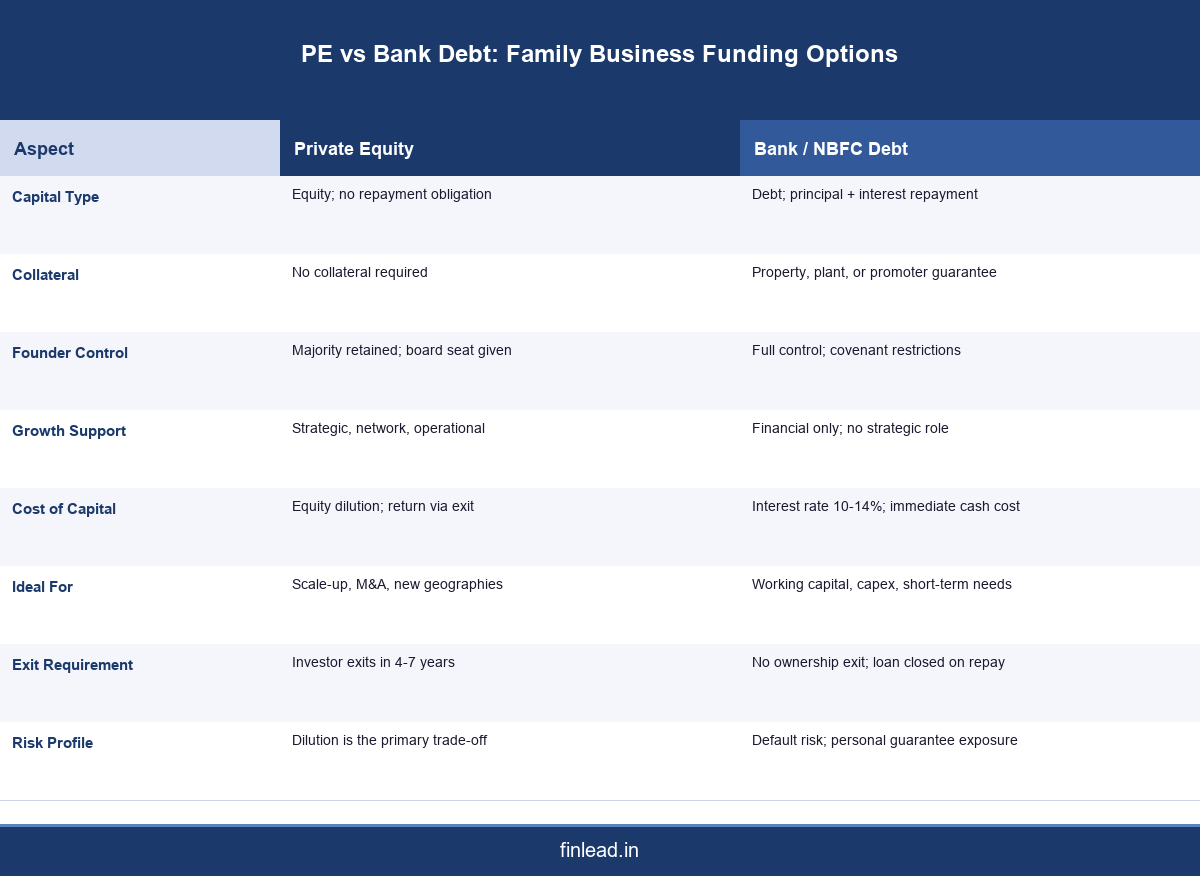
PE vs Bank Debt: Family Business Funding Options
Common Family Business Challenges in PE Fundraising
Family businesses seeking PE capital often encounter challenges that stem from the informal way most family enterprises are run. Commingling of personal and business finances is the most common issue. Founders who use business accounts for personal expenses, or who have transferred business assets to family trusts, create accounting complications that PE investors will flag in due diligence.
Related-party transactions between the business and family-owned entities, such as property leased from the promoter's personal holdings or purchases from a sibling's company, must be disclosed and justified at market rates. These are not necessarily deal-breakers, but undisclosed related-party arrangements discovered during due diligence can severely damage investor trust and sometimes kill transactions.
Succession uncertainty is a specific concern in family business PE transactions. Investors who back a business because of the founder's domain expertise and market relationships need to understand what happens if the founder steps back. Articulating a succession plan, whether family-based or professional management, reassures investors that the business will continue to perform after the initial generation transitions out of active management.
Structuring a Family Business PE Transaction
Before approaching PE investors, family businesses must ensure their legal and financial structure is investable. The business must be incorporated as a private limited company. Partnerships, proprietorships, and HUF structures cannot accept PE investment directly. If restructuring is required, it must be completed before investor engagement begins.
Family shareholding patterns must be clear. If multiple family members hold equity in various proportions due to historical gifts, inheritance, or inheritance anticipation, the shareholding structure must be documented and understood by all parties. Disputes among family shareholders are among the most common reasons PE transactions in family businesses fail at the due diligence stage.
Engaging a PE advisory firm at least 12 months before the target raise helps identify and resolve these structural issues before they become deal-blockers. The advisory firm also helps position the business's story in terms that PE investors find compelling, which accelerates the investor engagement process.
Building Governance Before PE Arrives
PE investors are attracted to family businesses that have already begun the transition from founder-centric to professionally governed organisations. A family business with an independent director, regular board meetings, documented risk management processes, and audited financials prepared under Ind AS is significantly easier to fund than one where all decisions pass through a single family patriarch.
Building governance proactively, before the first investor conversation, signals to PE funds that the management is serious about institutional-grade operation. It also reduces the time spent during due diligence on governance remediation, which shortens the overall transaction timeline and reduces advisory costs.
Key governance improvements to implement before fundraising include: constituting an independent audit committee, separating operational budgets from personal accounts, establishing documented HR and vendor management policies, and conducting an annual independent audit. These steps are low-cost but create disproportionate value in the investor's perception of the business.
How FinLead Supports Family Business PE Fundraising
FinLead has deep experience working with Indian family businesses through PE fundraising processes. We understand the unique dynamics of family-owned enterprises: the legacy concerns, the governance informalities, the multi-stakeholder ownership structures, and the emotional dimensions that make these transactions more complex than standard institutional fundraising.
Our advisory process begins with a confidential assessment of the business's PE readiness. We identify structural issues, governance gaps, and financial reporting improvements that need to be addressed before investor engagement. We build the financial model, prepare the information memorandum, manage investor outreach, and support term sheet negotiation with a focus on protecting founder interests.
Family business founders who have worked with us consistently report that the PE process was less disruptive and the outcome far better than they anticipated. If you are considering PE capital for your family business, contact FinLead for a confidential conversation today.
Private equity is not about giving up your business. It is about building a partnership that accelerates growth while preserving the foundation you have built. Indian family businesses that approach PE with the right preparation, the right governance, and the right advisory support consistently close transactions on terms that protect their control and amplify their legacy. Reach out to FinLead to start the process with confidence.
Frequently Asked Questions
Will PE investors take control of my family business?
No. PE investors in Indian family businesses typically take 25 to 40 percent minority stakes. You retain majority ownership and day-to-day operational control. Governance provisions give investors board representation and approval rights for major strategic decisions, not management authority.
What financial documents does a family business need for PE due diligence?
PE investors require two to three years of audited financial statements under Ind AS, a consolidated balance sheet, profit and loss accounts, cash flow statements, and a schedule of related-party transactions. Many family businesses need to upgrade their financial reporting before engaging investors.
How do PE investors exit from a family business investment?
Common exit routes include strategic sale to a larger business, secondary sale to another PE fund, or an IPO where the PE investor sells their listed stake. Exits are documented in the shareholders' agreement and do not require the family to sell the entire business.
Can a family business raise PE without a private limited company structure?
No. PE investors invest in private limited companies or LLPs. Partnerships, HUF structures, and proprietorships must be converted or restructured before PE investment can be received. This restructuring should be completed before investor engagement to avoid delays.
How are family businesses valued for PE investment?
Valuation depends on the sector, growth rate, EBITDA margins, and management quality. Comparable transaction multiples in the relevant sector provide a benchmark. Family businesses often trade at a discount to pure-play companies due to governance informality, which can be reduced through proactive governance improvements.
What governance rights will PE investors require in a family business?
PE investors typically require a board seat, information rights, approval thresholds for major financial decisions, and anti-dilution protections. Operational day-to-day management is generally left to the family-led management team. These provisions are negotiated and documented in the shareholders' agreement.
How long does a family business PE fundraising process take in India?
From advisory engagement to transaction close, family business PE deals typically take 10 to 15 months. Structural remediation, governance improvements, and financial clean-up can add 3 to 6 months if addressed during the process. Starting early is the single most effective way to shorten the timeline.
What is the difference between a PE raise and selling the business?
A PE raise is a minority equity investment where the family retains majority control and continues running the business. Selling the business transfers majority or full ownership to a buyer. PE raises are designed for growth; selling is a full or partial monetisation event.
How can family businesses protect their brand and legacy in a PE deal?
Shareholders' agreements can include provisions that restrict the investor from changing the company name, selling the brand, or approving transactions that fundamentally alter the business character without family consent. These protections should be negotiated with M&A advisory support before signing.
How does FinLead help family businesses raise PE capital?
FinLead provides end-to-end PE advisory: readiness assessment, structural clean-up, financial modelling, investor documentation, investor outreach, and term sheet negotiation. We specialise in founder-friendly deal structures that protect family control while accessing the growth capital the business needs. Contact us here.