Succession Planning for Business Owners: Family Handover, Management Buyout or Sale?
Succession Planning for Business Owners

Succession planning for business owners usually starts as a family question and ends as a transaction decision. Picture a 62-year-old Kerala promoter with a ₹120 crore business and a daughter whose career is in Bengaluru, an illustrative case we use throughout this guide. She may never come back, and nobody has said so aloud. That promoter has four real routes: a family handover, a management buyout, a PE partner or an outright sale. Most advice stops at family governance. This guide compares all four as a sell-side adviser would. General tax and legal points here should go to your own counsel.
Key Takeaways
- A promoter has four succession routes: family handover, management buyout, a PE partner, or an outright sale of the business.
- A family handover works only when the successor is willing and capable, and when the family has discussed both openly.
- Bank acquisition finance is built for large companies, so most management buyouts rely on deferred payments and outside investors.
- Plan on 12 to 24 months for a sale, because clean records and low promoter dependence take time to build.
What are the four succession routes for a promoter-led business?
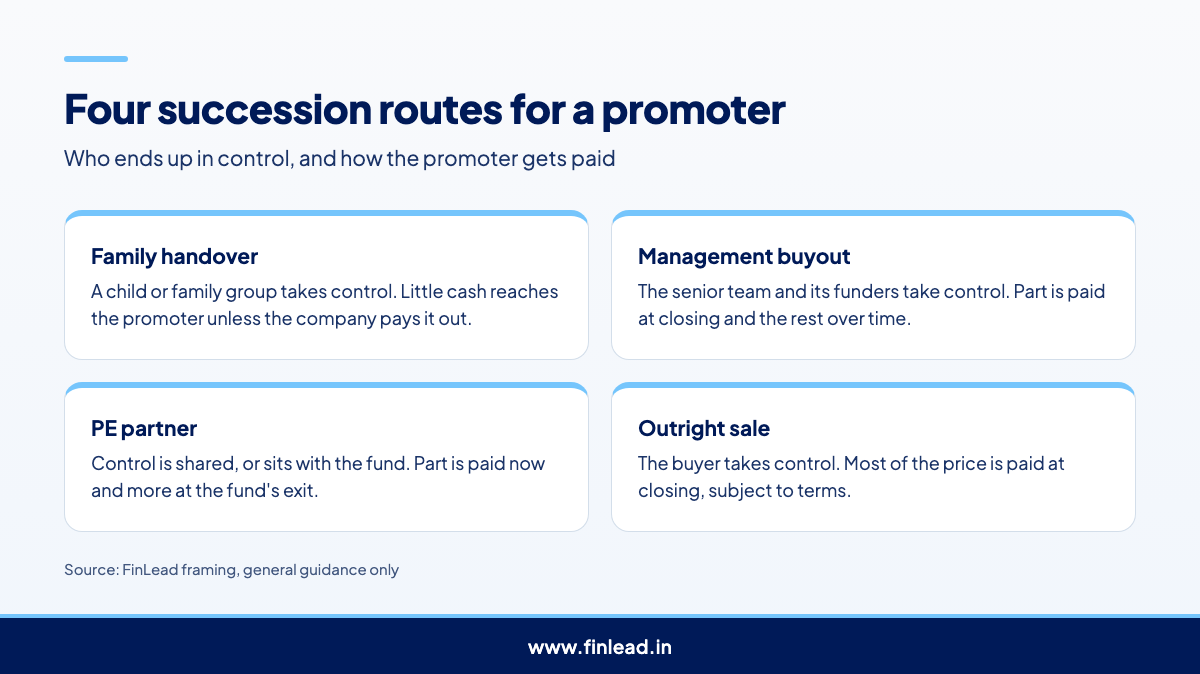
The first route is a family handover. Ownership and management pass to a child, a sibling or a wider family group, usually in stages. It keeps the name on the gate and the wealth inside the family. It also leaves the promoter's net worth locked in one company, and it depends entirely on one person's willingness and ability to run it.
The second route is a management buyout. Your senior team buys the business, usually with outside funding and with part of the price paid over time. It suits a company with a strong second line and a promoter who cares about continuity. It rarely delivers the whole price on day one, so you stay exposed to the company's performance for years.
The third route is a PE partner. A fund buys a minority or controlling stake, professionalises the company and exits later. Our guide to raising growth capital in a family business covers the capital raise itself. Here we treat it as a succession tool, because a partial sale can give a promoter liquidity and buy the next generation time to decide.
The fourth route is an outright sale to a strategic or financial buyer. It delivers the cleanest separation and usually the largest cash outcome at closing. It also ends family ownership, and many promoters find that harder to accept than any price negotiation. A sale should still count as succession, because the business carries on under owners who actually want to run it.
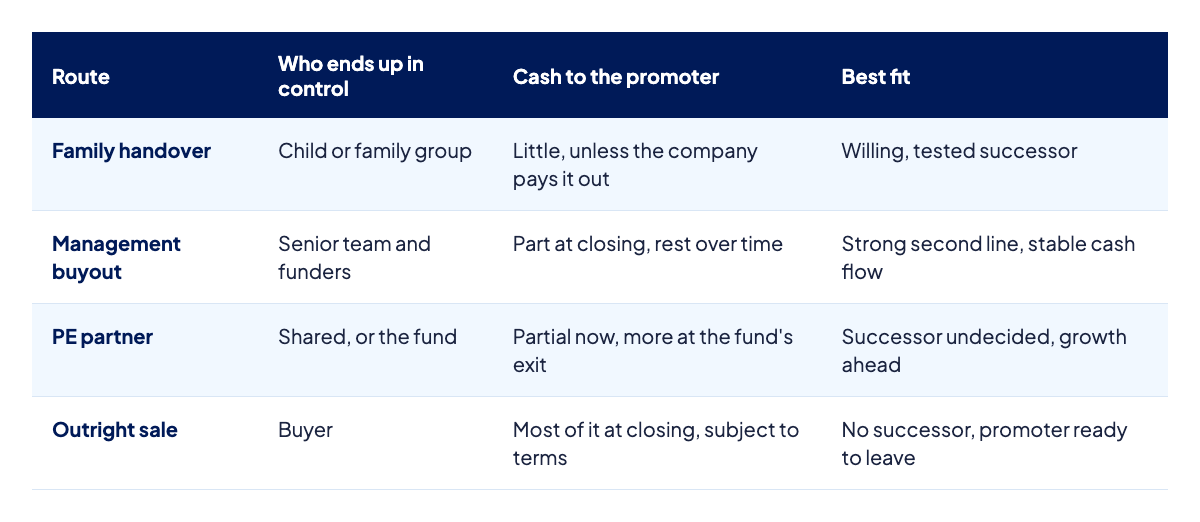
Sound succession planning for business owners often sequences two of these routes. A promoter can bring in a minority investor at 62, watch how the daughter responds over three years, and then sell or hand over. The table below compares the routes on the points that usually decide the matter. Treat it as a framing tool, because every family and balance sheet differs.
Why does the family handover fail more often than owners expect?
The most common failure is an assumption nobody has tested. Our Kerala promoter assumes his daughter will return when the time comes. She assumes he will sell when he tires. Both avoid the conversation because it feels like a verdict on the relationship. Meanwhile the years pass, and the business still depends on one man's relationships with banks and customers.
The second failure is treating ownership and management as one decision. A daughter may be an excellent shareholder and a reluctant managing director. A son in the business may be a fine operator while two siblings outside it expect dividends. Separate the two questions early. Who should own this company, and who should run it, can have very different answers in the same family.
The third failure is fairness between heirs. Equal shares feel fair at the dining table, but they can give an inactive sibling a veto over a working one. That tension usually surfaces after the founder has stepped back, when nobody has the authority to settle it. A shareholders' agreement, a clear dividend policy and an agreed buyout mechanism prevent most of these disputes from reaching a lawyer.
The fourth failure is a late start. A successor needs years of real authority, including the freedom to make mistakes while the founder is still around to help. A handover announced after a health scare gives nobody that time. It also weakens the company's position with lenders and key customers, who begin to wonder who will honour the commitments made over the last thirty years.
None of this makes family succession a poor choice. It works well when the successor wants the job, has earned it elsewhere and receives authority on a published timetable. Our note on whether PE is replacing traditional family handovers looks at the shift in more depth. The honest test is simple: would you hire this person if they were not family?
Management buyout: how is it funded and what does the founder keep?
A management buyout is rarely funded by the managers' savings. A team buying a ₹120 crore business needs far more than its members hold personally. The money usually comes from three places: a deferred payment to the promoter, an outside investor who backs the team, and whatever debt the company's cash flow can safely carry. The promoter is often the largest financier.
Bank debt is less available than many owners assume. RBI's 2026 framework lets banks fund acquisitions, but this law-firm summary of the acquisition finance rules describes a minimum acquirer net worth of ₹500 crore, three profitable years and a 75% loan cap. It also says the intent is not to permit classic leveraged buyouts. A managers' vehicle will not usually qualify.
So the structure does the work. An illustrative deal might pay the promoter 50% at closing, 30% over three years and leave 20% tied to profit targets. The promoter keeps a real stake in the outcome, and often a board seat until the final payment arrives. Our guide to earnouts, rollovers and founder incentives explains how these terms are drafted.
The founder should treat that deferred money as credit risk, because it is. If the team stumbles, your retirement income stumbles with it. Ask for security over shares, information rights, covenants on debt and dividends, and the right to step back in on default. These terms can feel harsh with people you have mentored for twenty years, so let your advisers negotiate them.
Valuation is the awkward part, since your buyers know every weakness in the company. Get an independent valuation before any number is mentioned, and test it against what an outside buyer might pay. Selling to your team at a friendly price is a legitimate choice, but make it knowingly. Your family should understand the size of that gift before you sign anything.
Can a PE partner act as a bridge to the next generation?
A PE partner can solve the problem that troubles many promoters most: the successor question is not ready for an answer, but the business needs capital and the founder needs liquidity. Selling a minority or joint-control stake now gives the family cash, brings in governance and defers the final decision. Our overview of the PE route for mid-market companies sets out what funds typically look for.
Two Indian deals show the shape, at a much larger size. Bain Capital agreed in March 2025 to take joint control of Thrissur's Manappuram Finance, with the promoter family set to hold 28.9%, according to Business Standard's report on the Bain and Manappuram deal. A family can share control and still stay invested.
The relationship can also run backwards. In November 2025, Kauvery Hospitals' promoters were reported to be in talks to buy back about 5% from an investor, Lightrock, according to Digital Health News on the Kauvery repurchase talks. A fund's stake need not lead straight to a sale, since promoters with the means can sometimes increase their holding when the investor wants out.
The discipline is that a fund must eventually exit. Our guide to how PE investors plan an IPO, sale or secondary explains the options. In practice, your shareholders' agreement will probably give the investor exit rights, and those can force a sale of the whole company. Read those clauses as succession clauses, because they may decide your family's future more than any will.
A bridge also has a cost in daily life. You will report to a board, publish monthly numbers and take questions on family salaries and related-party rent. Before you sign, ask your candidate successor whether they would want to work under that governance. Their answer will tell you a good deal about the handover itself.
Selling as succession: how long is the runway and what valuation prep pays?
In succession planning for business owners, selling is the route most consider last and should plan first. As a planning assumption, allow 12 to 24 months: roughly half to prepare the company and half to run the process and close. Regulated sectors can take longer. Our note on how long a deal takes to close in India breaks down the stages from first outreach to final payment.
The preparation that pays is mostly unglamorous. Move key customer and bank relationships away from yourself. Clear related-party rents and loans, separate family assets from the company and put property titles in order. Audit your numbers properly for three years. Each fix removes a reason for a buyer to cut the price, hold back money or walk away during diligence, usually late in the process.
The second priority is earnings quality. Buyers pay for profit they believe will continue without you. Remove family salaries that do not reflect real work, show one-off costs separately, and document your customer concentration before someone else does. Our explainer on valuation metrics and methods shows how buyers turn those adjusted earnings into a price they can defend to their investment committee.
Then choose the buyer type deliberately. A trade buyer may pay for synergies and absorb your brand. A financial buyer may keep the team and ask you to stay for a transition. Our comparison of how trade and financial acquirers differ goes further. Competitive tension matters as much as preparation, because a single bidder has little reason to pay full value.
Keep tax in the plan from the first day. Long-term gains on unlisted shares held for over 24 months are taxed at a flat 12.5%, with no indexation and no annual exemption, as Groww's guide to unlisted share tax explains. Asset sales, slump sales, gifts and family settlements are treated differently, and rules change. Ask your tax counsel to model each route before you commit.
A five-step succession plan checklist
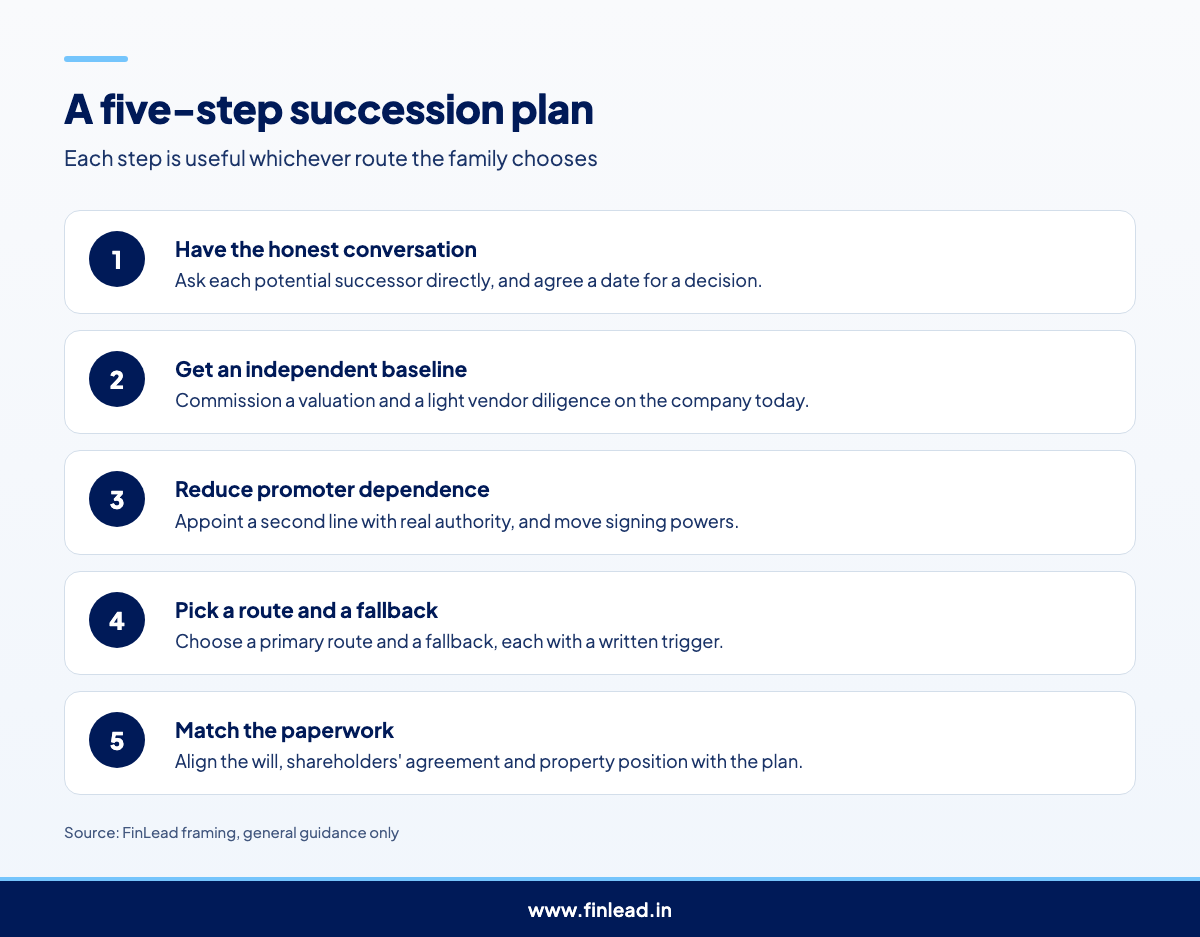
Step one is the honest conversation. Sit down with your spouse and each potential successor, separately and then together, and ask directly who wants what. Agree a date for a decision, even if the decision itself is to wait.
Step two is an independent baseline. Commission a valuation and a light vendor diligence on the company as it stands today. This tells you what the business would fetch, what would reduce that price and what your family's wealth really looks like. A small family business owner succession plan built on a guessed number is a plan built on hope.
Step three is reducing promoter dependence, whichever route you choose. Appoint a second line with real authority, move signing powers, and introduce those managers to your top customers and lenders. Every route benefits from this work, so it can begin before the family has decided anything. It also gives you evidence about whether your team could realistically run a buyout.
Step four is choosing a primary route and a fallback, each with a trigger. For example, the daughter decides by a set date; if she declines, the company opens a minority sale process within six months. Writing down the trigger removes much of the emotional drift that sinks family business ownership transition plans. Review the triggers every year with your advisers.
Step five is getting the paperwork to match the plan. That means a will, a shareholders' agreement, a clear position on family-held property and tested powers of attorney if you are incapacitated. Your legal and tax counsel should lead this work, and they should see the transaction plan as well. A beautiful strategy fails quickly when the share register says something different.
Conclusion
Good succession planning for business owners does not begin with choosing an heir. It begins by admitting that a handover, a buyout, a PE partner and a sale are all legitimate ways to protect what you built. Our illustrative promoter can have the conversation with his daughter this year, prepare the company regardless and keep every route open. If you would like to think through your own situation in confidence, you can book a private conversation with FinLead. We act as an adviser, and we will expect your tax and legal counsel in the room.
Frequently Asked Questions
What is succession planning for business owners in India?
It is deciding who will own and run your company after you, and how you will get paid. The answer can be a family handover, a management buyout, a PE partner or a sale, and each route needs different preparation.
When should a promoter start planning for succession?
Start while you are healthy and the business is performing, ideally many years before you intend to step back. A successor needs time with real authority, and a sale needs 12 to 24 months as a planning assumption, sometimes longer.
What if my children do not want to join the business?
Treat that as useful information rather than failure. You can promote professional managers, support a management buyout, bring in a PE partner or sell. Your children can remain shareholders or receive the proceeds without ever having to run the company.
How is a management buyout usually funded in India?
It usually combines deferred payments to the promoter, an outside investor backing the team, and debt the company can service. RBI's bank acquisition finance rules set high eligibility bars, so a managers' vehicle will rarely qualify on its own for that funding.
Does bringing in a PE partner mean losing control of my company?
Not necessarily, since funds also buy minority or joint-control stakes. However, investors usually negotiate veto rights and exit rights. Those clauses can eventually force a sale, so ask your counsel to review them closely before you sign the shareholders' agreement.
How much tax applies when I sell unlisted shares?
Long-term gains on unlisted shares held for over 24 months are taxed at a flat 12.5%, without indexation. Surcharge, deal structure and your personal position all change the final figure, so ask your tax counsel for a calculation before you decide.
What do buyers check first in a family-run business?
They usually start with related-party dealings, family salaries, property titles and how much depends on the promoter personally. Our note on compliance gaps that worry acquirers lists problems worth fixing long before you approach anyone at all.
Can I sell part of the business now and the rest later?
Yes, staged sales are common, and our primer on how deal terms are put together explains the mechanics. Agree the valuation method, control rights and timing of the second stage in writing, because later disagreement about them can become expensive.