How Traditional Indian Businesses Can Use PE to Fund Expansion
How Indian Businesses Can Use PE to Fund Expansion

India's traditional business sector, encompassing generations-old trading houses, manufacturing units, logistics businesses, and service enterprises, represents a vast and largely untapped opportunity for private equity capital. These businesses often have strong relationships, established customer bases, and deep operational knowledge, but their financial reporting, governance structures, and capital infrastructure are rarely built for institutional investment.
This guide explains how PE funding traditional business India works in practice: what PE investors look for in established businesses, how traditional enterprises must prepare, and why the businesses that bridge the gap between legacy operations and institutional standards consistently achieve the best outcomes.
Key Takeaways
- Traditional businesses with strong revenue, customer relationships, and sector knowledge attract PE investment when they formalise their operations and financial reporting.
- The gap between a traditional business and a PE-ready business is typically financial transparency, governance, and scalability documentation, all of which are achievable.
- A [PE advisory firm](https://www.finlead.in/pe-advisory/) helps traditional business owners navigate the transition to institutional-grade operation and access growth capital on founder-friendly terms.
Why Traditional Businesses Are Increasingly PE Targets
PE investors have historically focused on technology companies and high-growth consumer businesses. Over the past decade, however, a significant shift has occurred. As competition for tech assets has pushed valuations beyond sustainable levels, PE funds have moved into traditional sectors, recognising that well-run, asset-light or moderately asset-intensive businesses in manufacturing, logistics, distribution, and services offer better risk-adjusted returns at reasonable entry valuations.
Traditional businesses often have characteristics that PE investors prize highly: loyal, repeat customers with multi-decade relationships; proprietary processes or market positions built over generations; deep supplier networks that create competitive barriers; and trusted brand names in their regional or sectoral markets. When these advantages are combined with proper financial infrastructure and governance, the investment case is compelling.
The post-GST formalisation of India's economy has made many traditional businesses more investable than they were five years ago. GST compliance creates an auditable revenue trail that gives PE investors confidence in the financials. Digital payments adoption has reduced undocumented cash transactions. The formalisation wave is converting previously uninvestable traditional businesses into credible PE targets, and investors are taking notice.
What Makes a Traditional Business PE-Ready
The transition from a traditional operating business to a PE-ready enterprise requires work in four core areas: financial transparency, legal and corporate structure, governance, and scalability documentation.
Financial transparency means that the business has audited accounts, that revenue is fully documented through invoices and bank transactions, and that there are no unexplained cash flows or undisclosed liabilities. Many traditional businesses have been profitable for decades but have maintained accounts that blend personal and business finances, carry undisclosed liabilities, or report revenue that is incomplete due to historical tax management practices. Cleaning this up is the most important and often the most time-consuming preparatory step.
Legal and corporate structure must be investor-friendly. The business should be incorporated as a private limited company with a clean cap table that clearly shows who owns what and on what terms. Any HUF assets, partnership interests, or trust holdings mixed with the operating business must be separated before investor engagement. Pending litigation, tax demands, or regulatory notices must be disclosed and, where possible, resolved.
Documenting the Scalability Case
PE investors do not fund businesses purely on the basis of past performance. They fund the growth case: the evidence that investing capital in the business will generate returns above their hurdle rate. For traditional businesses, building this growth case requires more deliberate work than for high-growth startups, where the trajectory is already visible.
The scalability documentation for a traditional business should answer several questions: Why has the business been successful, and what is the underlying competitive advantage? What is the total addressable market, and what share does the business currently hold? What specific investments, such as additional manufacturing capacity, new locations, or technology infrastructure, would allow the business to grow at 20 to 30 percent annually? What is the payback period on each investment? Answering these questions with data and evidence, rather than assertions, is what converts a traditional business into a compelling PE investment opportunity.
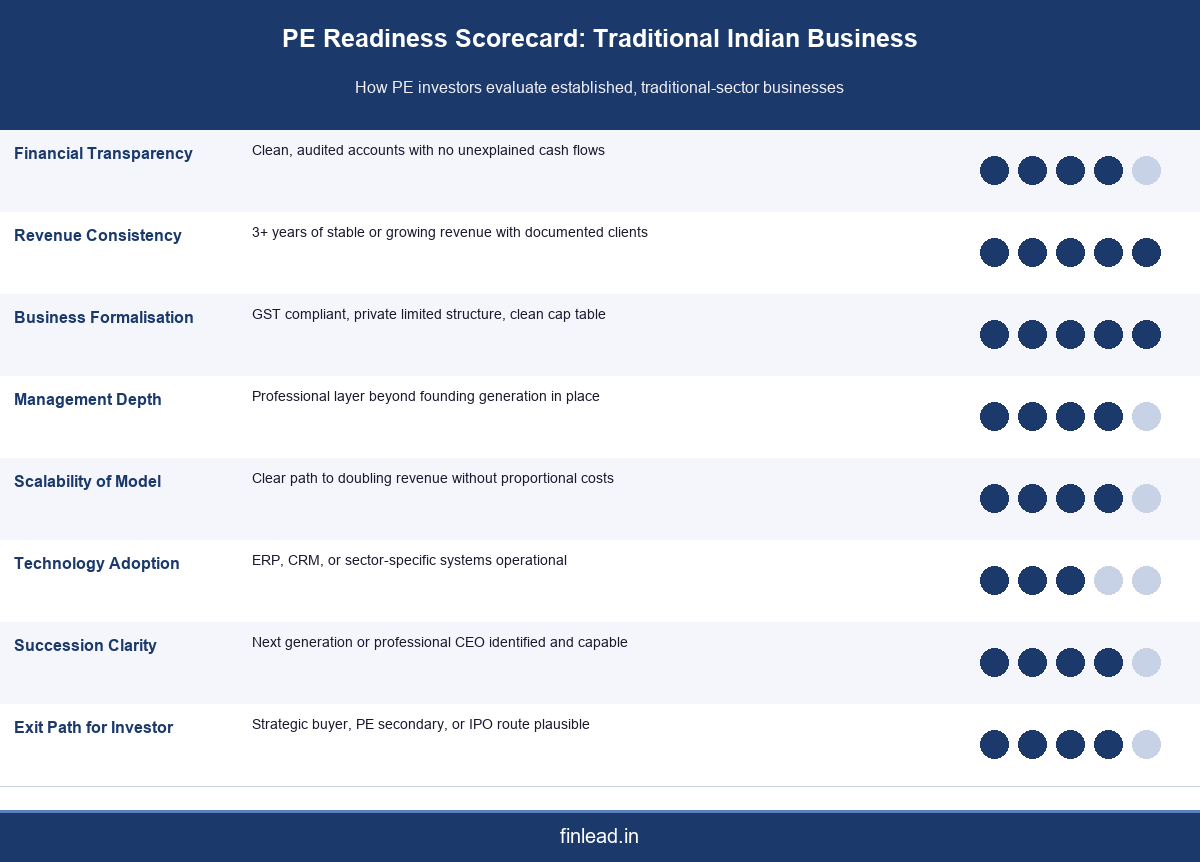
PE Readiness Scorecard: Traditional Indian Business
Governance and Management Modernisation
Governance is a consistent concern in traditional business PE transactions. Many traditional enterprises are run entirely by the founding family, with all decisions flowing through one or two key individuals. This concentration of authority creates operational risk that PE investors must price into their investment thesis, and it limits the scalability of the business beyond the founding generation's capacity.
Transitioning to a more distributed decision-making structure, with professional managers in functional roles and documented policies for key business processes, is an important step in PE preparation. This does not mean replacing the founder. It means building a team around the founder so that the business can execute on multiple fronts simultaneously and continue to operate effectively even if key family members are unavailable.
PE investors frequently support the cost of key hires as part of their investment thesis. Positioning management team strengthening as a stated use of proceeds for the PE investment is a credible and effective approach, particularly for businesses that are genuinely capacity-constrained by their current management depth.
Technology Adoption and Digital Infrastructure
Technology adoption is increasingly a prerequisite for PE investment in traditional businesses. Investors who cannot get real-time data on revenue, inventory, receivables, and margins cannot model the business or track their investment. A business running on spreadsheets, WhatsApp, and undocumented manual processes is genuinely harder to invest in than one with an ERP system, digital invoicing, and a CRM.
The specific technology requirements depend on the sector. Manufacturing businesses need production tracking, inventory management, and quality control systems. Trading and distribution businesses need order management, logistics tracking, and receivables monitoring. Service businesses need project management, billing, and customer relationship management tools.
Investing in the right technology stack before PE fundraising, even if it requires 6 to 12 months of implementation work, significantly improves the quality and speed of the investor conversation. It also makes the due diligence process faster, reducing the overall transaction timeline and cost.
Approaching PE Investors for Traditional Business Fundraising
Traditional business founders are often uncertain about how to approach PE investors. The first step is engaging a fundraising advisory firm that understands both the traditional business context and the PE investor landscape. The advisory firm will assess the business's readiness, identify the remediation steps required, and build the investor documentation that positions the business correctly.
The information memorandum for a traditional business must tell a differentiated story. It must explain why this specific business, in this specific market, with this specific team, is a better investment than the dozens of similar businesses in the PE fund's pipeline. The story must connect the business's historical competitive advantages to a credible, capital-backed growth plan that delivers the returns PE investors require.
Targeting the right PE funds is as important as having the right documentation. Not all PE funds invest in traditional businesses. Sector-focused funds with a track record in the relevant industry are the most efficient place to start. A PE advisory firm with active fund relationships ensures the business reaches the right investors quickly, without wasting time on funds that are unlikely to engage.
Traditional Indian businesses have built competitive positions that took decades to create. PE capital is the most effective tool for accelerating the growth of those positions in the modern economy. The founders who understand this, and who take the steps to make their businesses investor-ready, consistently access capital on better terms and achieve faster growth than those who rely on debt alone. Contact FinLead to explore how we can support your traditional business's PE fundraising journey.
Frequently Asked Questions
Can a traditional trading or manufacturing business raise PE investment in India?
Yes. PE investors are increasingly active in traditional sectors, recognising the competitive advantages, customer loyalty, and market positions built over decades. The key is financial transparency, corporate structure, and a documented scalability case that shows how capital will generate above-market returns.
What are the most common obstacles for traditional businesses in PE fundraising?
The most common obstacles are undocumented or informal financial records, commingling of personal and business accounts, complex or unclear ownership structures, undisclosed related-party transactions, and a lack of documented processes or governance. These issues are solvable but require preparation time.
How long does it take to make a traditional business PE-ready?
Depending on the starting point, preparing a traditional business for PE investment typically takes 12 to 18 months. The main time-consuming steps are financial clean-up, corporate restructuring, technology implementation, and governance improvement. Starting the process early is essential for a timely fundraise.
What valuation can a traditional business expect from PE investors?
Traditional businesses in defensible market positions typically trade at 6 to 12 times EBITDA in PE transactions, depending on the sector, growth rate, and governance quality. Businesses with clear scalability, low customer concentration, and modern governance can command the higher end of this range.
Do PE investors want to replace the founder of a traditional business?
No. PE investors in traditional businesses invest because of the founder's market position, customer relationships, and operational expertise. They want the founder to remain active. What they do want is a management team around the founder that reduces key-person dependency and enables faster execution.
What sectors of traditional business are most attractive to PE investors in India?
PE investors are most active in traditional businesses within specialty manufacturing, logistics and warehousing, healthcare services, food processing, building materials, chemicals and intermediates, and B2B distribution. Businesses with proprietary market positions or exclusive supplier relationships in these sectors attract the most interest.
How does PE investment differ from bank loans for traditional businesses?
PE investment is equity capital with no repayment obligation. It comes with strategic support, governance, and network access. Bank loans provide capital that must be repaid with interest and are typically collateral-backed. PE is suited for growth and transformation; debt is suited for working capital and short-term capex.
What governance changes do PE investors require in traditional businesses?
PE investors typically require an independent board director, a professional CFO or finance head, documented approval processes for major decisions, and quarterly investor reporting. These are manageable changes that strengthen the business operationally and do not affect day-to-day founder authority.
Can a traditional business raise PE without giving up majority control?
Yes. The standard PE transaction structure for growth-stage investments involves a 25 to 40 percent minority stake. The founder retains majority equity and operational control. Governance provisions give the investor visibility and approval rights for major decisions, not control of the business.
How does FinLead help traditional businesses access PE funding?
FinLead guides traditional business owners through the full PE readiness and fundraising journey: financial clean-up, structure, financial modelling, investor documentation, investor outreach, and deal negotiation. Contact us for a confidential advisory assessment.