Best Investment Banks in India for a ₹50 to 500 Crore Business: How to Pick the Right Tier
Best Investment Banks in India for a ₹50 to 500 Crore Business

Search for the best investment banks in India and you mostly find career listicles that rank employers for graduates. A promoter selling a ₹50 to 500 crore business needs a different answer. The useful question is which bank will return your call, put a senior person on your deal and reach the right buyers. This guide sorts advisers into four tiers by the deals they tend to run, then gives you a scorecard for your shortlist. You can read who we are and how we work, and we sit in the fourth tier, so weigh our view knowing that.
Key Takeaways
- League tables rank advisers by deal value, so one very large transaction can move a bank to the top.
- Indian banks do not publish minimum mandate sizes, so ask each one directly what it has closed in your band.
- A ₹50 to 500 crore seller usually gains more from partner time and sector buyer reach than from a famous name.
- Score every shortlisted bank on the same ten points, and insist on meeting the person who will run your deal.
Why Does "Best" Depend on Your Deal Size, Not League-Table Rank?
League tables answer one question well: who advised the most money. Venture Intelligence's table for the first half of 2026 puts Morgan Stanley first with 3 deals worth US$4.7 billion. JP Morgan followed with 2 deals worth US$4.5 billion, and Goldman Sachs with 2 deals worth US$4 billion. All three worked on one transaction, Sun Pharma's purchase of Organon, which explains much of that order.
Now look at the same table by volume. Ernst & Young advised 21 deals worth US$2.3 billion and Avendus advised 12. On our arithmetic, Morgan Stanley's deals averaged about US$1.57 billion, while Ernst & Young's averaged about US$0.11 billion. Both are excellent at what they do. They are simply doing different work, for different clients, at very different ticket sizes.
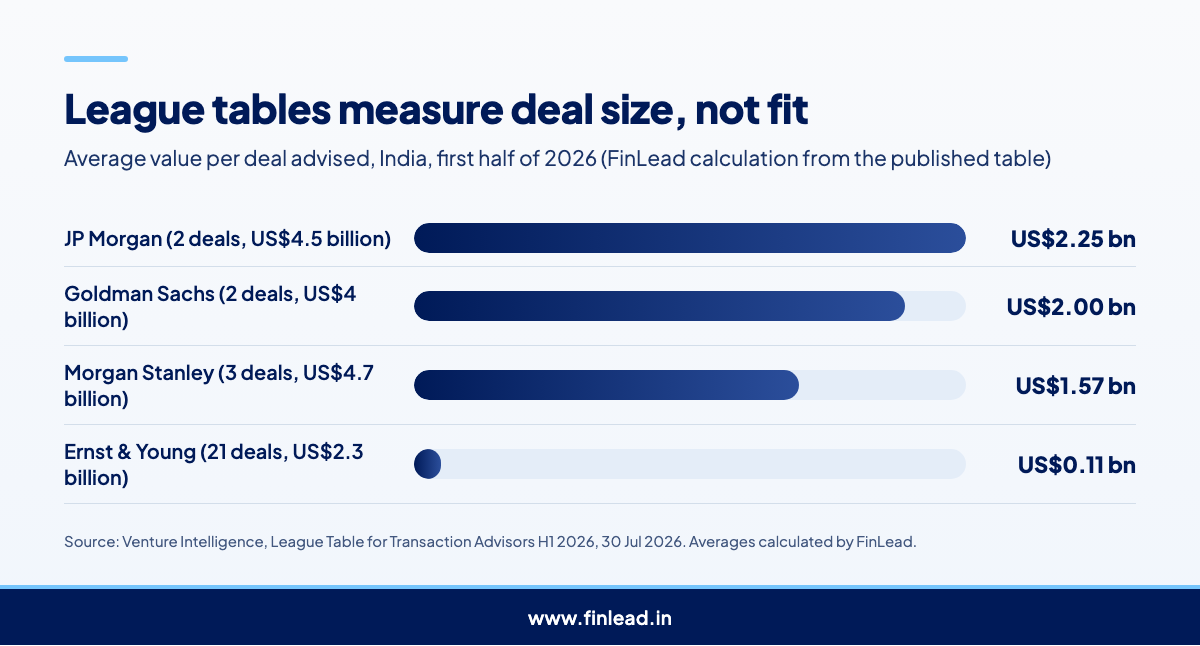
So a list of the top 10 investment bank in India tells a seller little. Consider a second-generation Thrissur spice exporter with a clean ₹120 crore business. The name at the top of the table may never run a process that size. Even if it agreed, the exporter would compete for attention with mandates worth a hundred times more. Rank measures scale, and scale is not fit.
Fit has three parts, and they are all testable before you sign. The first is whether the firm has recently closed deals of your size. The second is whether it knows your buyers by name, not by category. The third is who will actually pick up the phone in month five, when diligence has gone quiet and a buyer starts retrading the price.
Regulation adds one more filter, though it rarely decides a private sale. SEBI's amended rules set a ₹50 crore net worth for Category I merchant bankers and ₹10 crore for Category II. Only Category I may lead a mainboard IPO. If a listing is genuinely on your horizon, ask about registration early. If you are selling privately, ask your counsel what applies.
What Are the Four Tiers of Investment Banks in India?
Think of the market as four tiers, separated mainly by the deals each one is built to run. No Indian bank publishes a minimum mandate, so the bands below are our own illustrative reading, not published cut-offs. Use them to frame the conversation, then test them. The only reliable check is to ask what the firm has closed in your band in the last two years.
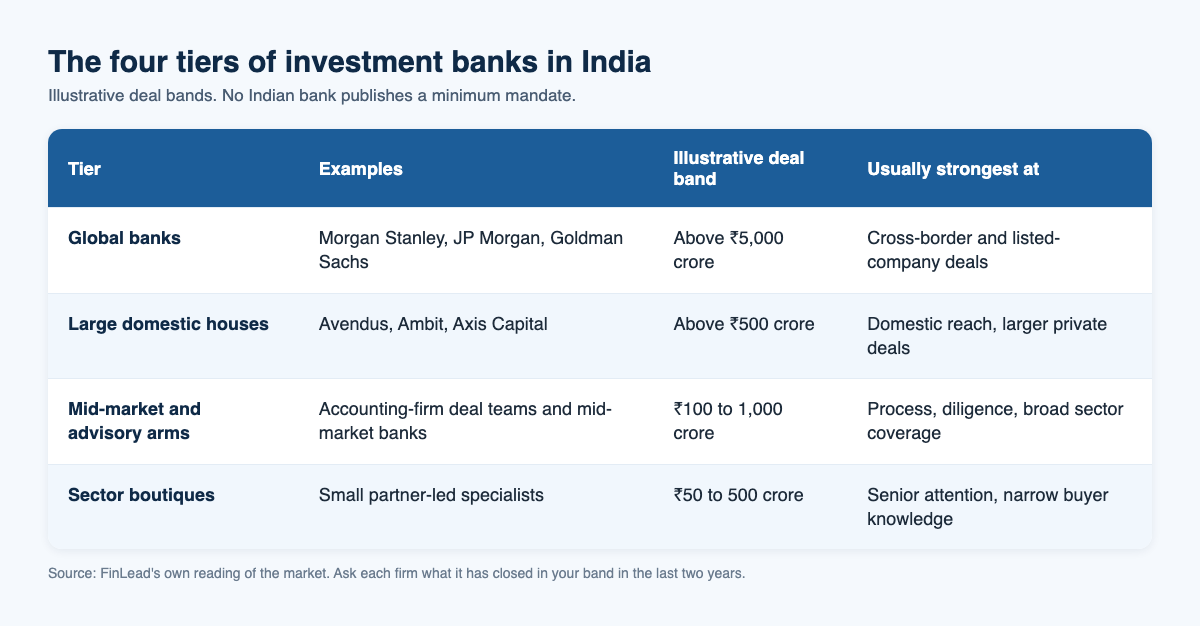
The first tier appears in those league tables for a reason. Global banks are built for transactions like the Organon deal, with cross-border teams and access to overseas boards. A promoter in the ₹50 to 500 crore band rarely meets this tier as a sell-side client. You may still meet it across the table, advising a large buyer that wants your business.
The second tier covers the large domestic houses, such as the names shown above. The same Venture Intelligence table records Ambit advising on a US$1.6 billion toll road deal and Avendus leading the IT and ITES table by value. These firms have real reach among Indian promoter groups and funds. The honest question is whether your deal would be the size their senior bankers personally run.
The third tier is broad. It includes the deal teams of accounting networks and the dedicated mid-market banks. Their strength is a disciplined process and wide coverage across sectors, and many have strong diligence benches beside them. Ernst & Young's 21 deals in six months shows the throughput possible. Check how many of those mandates are full sell-side processes rather than diligence or valuation work.
The fourth tier is where most lists of top boutique investment banks in India point. These are small, partner-led firms that focus on a few sectors or one geography. FinLead works here, as an adviser whose published transaction record is mostly M&A and early-stage funding rounds. The risk is capacity: a small firm has fewer people, so ask how many live mandates each partner carries today.
What Does a ₹50 to 500 Crore Promoter Gain and Lose at Each Tier?
Partner time is the biggest variable. At the top two tiers, a ₹150 crore mandate may sit with a capable junior team, with the senior name appearing at the pitch and at closing. At a boutique, the partner often writes the pitch and takes the buyer calls. Neither is automatically better. What matters is the person running your deal, so have that name written into the letter.
Buyer reach cuts the other way. A big house can phone a global strategic's corporate development head and be heard quickly. A boutique usually has fewer of those relationships but may know every realistic acquirer in one narrow niche. A Kochi IT services founder and a Chennai auto-component supplier need different lists. Ask to see an unnamed but specific buyer map before you decide, and test it.
Fees follow the same logic, and exact terms vary widely. A typical letter combines a retainer, a success fee and often a minimum fee, and every one of those is negotiable before you sign. Minimum fees matter most in this band. An illustrative ₹2 crore minimum on a ₹50 crore deal is 4% of the price, whatever the headline percentage says.
Your deal may also not be a pure sale, which changes the tier that suits you. A promoter raising growth capital needs a bank that knows the funds, and that can be a different firm from the one that knows trade buyers. See how a fundraise mandate works and how PE exits differ from trade sales before you fix the brief you give each bank.
Valuation promises deserve suspicion at every tier. Any bank can quote an impressive number in a pitch, and the lists of top investment banking companies in India do not test that habit. Ask how the figure was built. A credible banker will walk through the metrics behind a deal price, name the assumptions and tell you what would pull the number down. The answer tells you a lot about how they will behave later.
India M&A in 2026: Deal Value Is Up and Deal Count Is Down. What Does It Mean for Sellers?
The headline numbers look strong. LSEG data shows India M&A reached US$86.9 billion in the first half of 2026, up 31%, while deal volumes fell 8%. The second quarter alone contributed US$66.9 billion, the highest quarterly total since 2022. The report attributes this to a handful of large restructurings and cross-border acquisitions. In other words, fewer deals carried much bigger cheques, and that is the shape behind the headline.
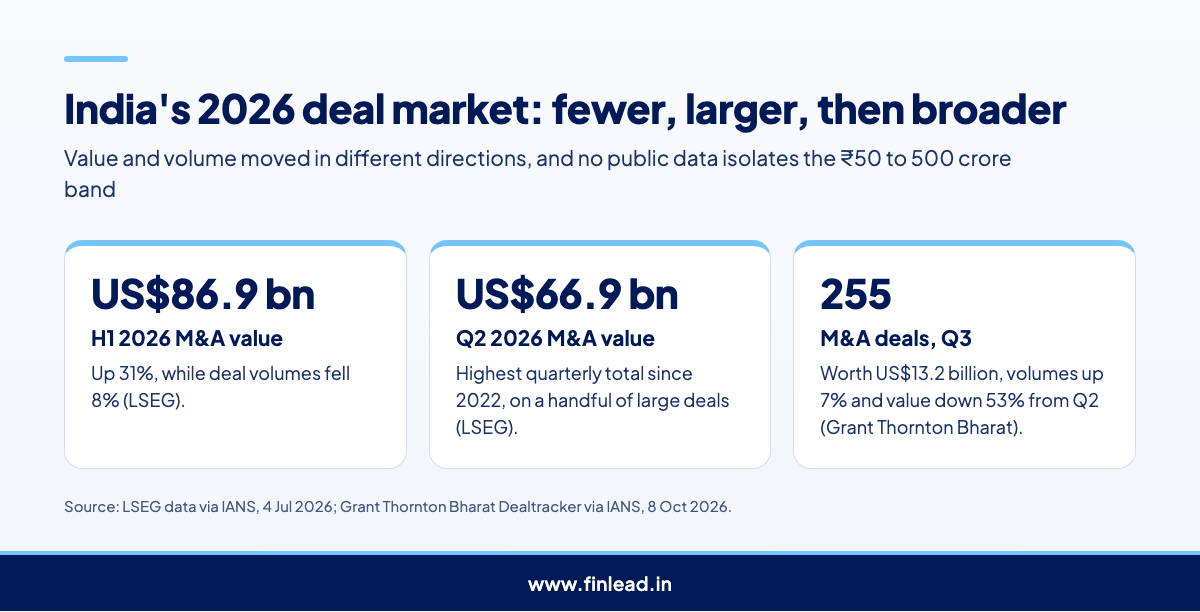
Please do not read those numbers as a verdict on your own business. We could find no public 2026 split of Indian deals by the ₹50 to 500 crore band, so nobody can honestly say how that band performed. Trackers also count differently, as Grant Thornton Bharat put Q2 M&A value at US$27.9 billion against LSEG's US$66.9 billion. Compare direction across sources, and never rely on a single total.
The next quarter looked different again. Grant Thornton Bharat's Q3 figures show 255 M&A deals worth US$13.2 billion, with volumes up 7% and value down 53% from Q2. The largest deal was US$1.9 billion, against US$11.8 billion in the previous quarter. So activity broadened while headline value fell. Two quarters cannot set a trend, but they do warn against timing a sale on headlines.
What should a seller take from this? Buyers remain active, and they are choosy. A well-prepared business with clean numbers and a credible growth story can still run a real process. A loosely prepared one will take longer, and it may never reach a term sheet. Preparation is the part you control, and it is also where a good adviser should start.
It also changes what you should ask a bank. Ask how many of its live conversations are with buyers who have actually closed a deal your size in the last two years. Ask which of trade buyers and financial sponsors are likeliest for your business and why. An answer built on named behaviour is worth more than a market report quoted back to you.
A 10-Point Scorecard for Shortlisting an Investment Bank
Lists of India top investment banks are a starting point for names, not for decisions. Take three or four firms from at most two tiers and score each from one to five on the points below. Add the scores only after you have met the person who will actually run the mandate, because that meeting changes more answers than any pitch deck does.
- Closed deals in your size band in the last two years, with references you can phone.
- Closed deals in your sector, or a clear reason why the skills carry over.
- The named lead banker, and how many live mandates that person carries today.
- A specific buyer map, with reasons for each group of buyers on it.
- A valuation view built from evidence, including what would lower the number.
- Fee structure in writing: retainer, success fee, minimum fee, expenses and the fee base.
- Exclusivity term and tail clause, with clear exit rights if the process stalls.
- Conflicts: other mandates in your sector and any relationships with likely buyers.
- Confidentiality plan, including how and when your staff and customers might learn of it.
- Honest fit: whether they told you what is weak, and what to fix before launch.
The last point matters more than it looks. A banker who tells you to wait six months and fix your customer concentration is giving up a near-term fee. One who agrees with everything may simply want the mandate. References help here too. Ask a former client what went wrong during their deal, and how the banker behaved when it did.
Then run a simple tie-break. If two firms score the same, prefer the one whose lead banker knows your buyers personally and has time for you this quarter. Compare how sell-side and buy-side mandates differ if a firm works both ways, because the conflict question then becomes sharper. Write your reasons down, since memory flatters a good pitch.
Conclusion
The best investment banks in India for your business are the ones that close deals your size, know your buyers and give you senior time. League tables cannot tell you that, but ten direct questions can. Start with the tier that fits, keep the shortlist short and get every term in writing before you sign. If you own a technology or services business in the ₹50 to 500 crore band and want a frank second opinion on your shortlist, speak to our deal team about a sale mandate.
Frequently Asked Questions
Which are the best investment banks in India for a mid-sized company?
There is no single answer, because fit depends on deal size and sector. Look for a firm that has recently closed deals in your band, knows your likely buyers and will commit a named senior banker to your mandate throughout.
Do investment banks in India publish a minimum deal size?
We could not find any Indian bank that publishes one, and thresholds move with market conditions. Ask each firm directly what it has closed at your size in the last two years. Ask for references you can actually phone yourself.
What is a success fee in a sell-side mandate?
It is the fee paid when the deal completes, usually the largest part of the adviser's pay. It can be flat, a percentage or both. Check what counts as transaction value, because that definition decides how much you actually pay.
Should I pay a retainer to an investment bank?
Many firms ask for one, and a modest retainer can show mutual commitment. Ask whether it is credited against the success fee and how long it runs. Avoid open-ended monthly payments that continue after the process has clearly stalled.
What does exclusivity mean in a mandate letter?
It means one adviser alone runs the transaction for a set period, and is paid if a covered deal happens in that time. Ask your counsel to review the length of the term, the notice period and any carve-outs before signing.
How long does it take to sell a business in India?
FinLead's own guide on how long a deal takes to close puts the typical range at 6 to 12 months. Cross-border or regulated deals can extend to 24 months. Good preparation before launch is the factor you control most directly.
Is a boutique or a large bank better for a ₹100 crore sale?
Often a boutique or mid-market firm, because your deal gets senior attention there. A large house can still suit you if it has a real buyer connection and commits a named senior banker. Test both against the same scorecard before deciding.
Do I need a SEBI-registered merchant banker to sell my company?
A public issue requires one, and only Category I firms may lead a mainboard IPO. For a private sale, the requirement depends on the structure, so ask your legal counsel. Any adviser should state its own registration status to you in writing.
How should earn-outs affect the choice of bank?
Ask how a bank charges on money you may never receive. Fees are often calculated at closing as though the full earn-out will be paid. Read how founder earn-outs and rollovers work, then negotiate payment when you actually receive it.