Buy-Side vs Sell-Side M&A Advisory: What Tech Founders Need to Know
Buy-Side vs Sell-Side M&A Advisory Guide

When a tech company enters an M&A transaction, one of the first and most important decisions is choosing the right type of advisor. Buy side m&a advisory and sell-side advisory serve fundamentally different purposes, and understanding which side you are on can determine the outcome of your deal. Whether you are looking to acquire a company or exit your own business, this guide will help you make an informed decision.
Key Takeaways
- Buy-side advisors represent the acquirer; sell-side advisors represent the company being sold.
- Each advisory type requires a different skill set, network, and deal strategy.
- Choosing the wrong type of advisor is one of the most common mistakes tech founders make in M&A.
What Is Buy-Side M&A Advisory?
Buy-side M&A advisory refers to the advisory services provided to a company that is looking to acquire another business. The buy-side advisor acts as a strategic partner to the acquirer, helping identify targets, evaluate fit, structure the deal, and negotiate terms that protect the buyer's interests.
In the technology sector, buy-side mandates are common among companies looking to scale through acquisition rather than organic growth. An IT services firm acquiring a niche consulting practice, for example, would engage a buy-side advisor to source targets, conduct preliminary screening, and manage the entire acquisition process.
For tech companies pursuing growth through acquisition, FinLead's M&A advisory services offer structured buy-side support with a focus on technology transactions.
What Is Sell-Side M&A Advisory?
Sell-side M&A advisory represents the interests of the business owner or shareholders who are looking to sell or exit the company. The sell-side advisor is responsible for preparing the company for sale, identifying and approaching prospective buyers, managing the information process, and negotiating deal terms in favour of the seller.
For tech founders who have spent years building a company, sell-side advisory is particularly critical. A good sell-side advisor understands how to position your business, craft a compelling narrative, and create competitive tension among multiple buyers to maximize your exit valuation.
FinLead has supported founders across India and internationally through structured sell-side exits with measurable outcomes across 90+ completed transactions.
Key Differences Between Buy-Side and Sell-Side Advisory
The most obvious difference is which party the advisor represents. However, the differences run deeper than that.
Buy-side advisors focus on target identification, synergy analysis, valuation benchmarking, and deal structure that minimizes acquisition risk. Sell-side advisors focus on business preparation, buyer outreach, competitive bidding processes, and maximizing the seller's proceeds.
In terms of process, sell-side mandates typically begin with a preparation phase that includes building a confidential information memorandum (CIM) and a teaser document. Buy-side mandates often begin with defining acquisition criteria and building a pipeline of potential targets.
Fee structures also differ. Sell-side advisors often charge a success fee as a percentage of the deal value. Buy-side advisors may charge a combination of a retainer and a success fee, depending on the engagement structure.
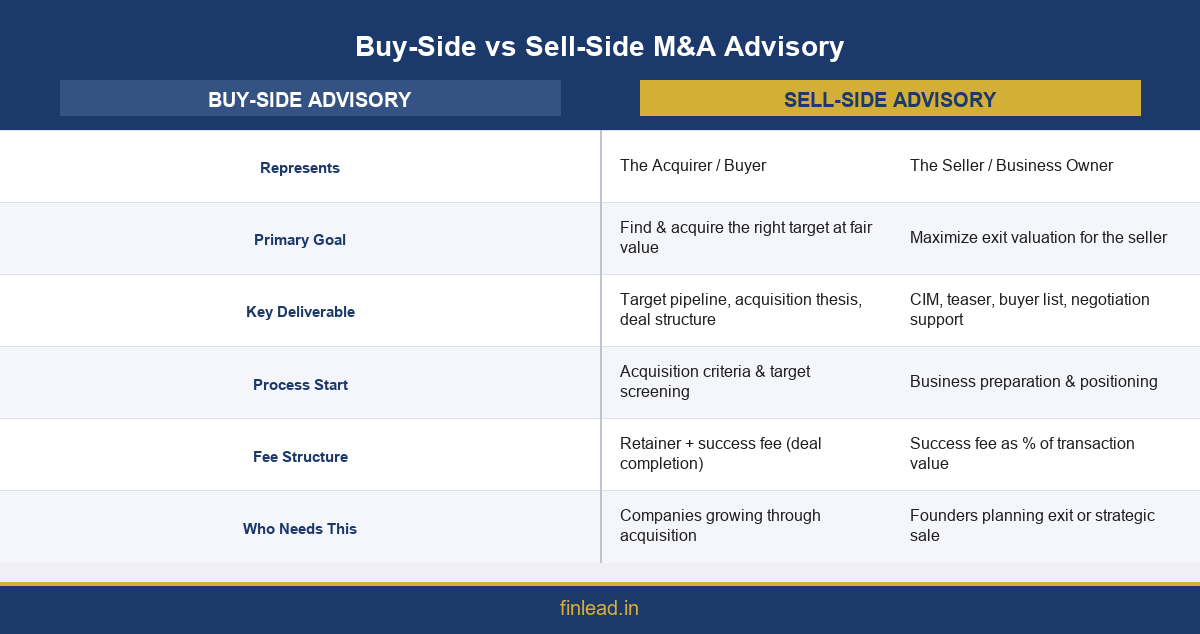
Which Advisory Type Does Your Tech Company Need?
If you are a founder looking to exit your business, merge with a larger player, or bring in a strategic investor, you need sell-side advisory. Your goal is to find the right buyer, maximize your valuation, and ensure the deal structure protects your interests and your team.
If you are a tech company looking to grow through acquisition, enter a new market, or consolidate a fragmented sector, you need buy-side advisory. Your goal is to find targets that fit your strategy, acquire at a fair price, and integrate effectively post-close.
FinLead advises both acquirers and sellers. To discuss which type of advisory is right for your situation, get in touch with the team.
How to Choose the Right M&A Advisor for Your Tech Company
Whether you need buy-side or sell-side support, the quality of your advisor will significantly influence the deal outcome. When evaluating an M&A advisor, look at their track record in technology transactions, their network of buyers or targets relevant to your sector, and their ability to manage complex cross-border processes.
Conclusion
Understanding the difference between buy-side and sell-side M&A advisory is the first step in approaching any transaction with clarity. Both advisory types require expertise, relationships, and structured processes that go far beyond what most founders can manage on their own. If you are considering an acquisition or a sale, engaging the right advisor early can make the difference between a good deal and a great one. To explore how FinLead can support your transaction, contact the team today.
Ready to take the next step? Contact FinLead today for a confidential discussion about your M&A goals.
Frequently Asked Questions
Q1: What is buy-side M&A advisory?
Buy-side M&A advisory supports companies that want to acquire other businesses. Advisors help identify targets, evaluate strategic fit, conduct due diligence, and negotiate deal terms on behalf of the acquirer.
Q2: What is sell-side M&A advisory?
Sell-side M&A advisory represents business owners looking to sell or exit. Advisors prepare the business, approach prospective buyers, manage the sale process, and negotiate to maximise the seller's deal value.
Q3: When should a tech founder hire an M&A advisor?
Founders should engage an M&A advisor at least 12 to 18 months before a planned exit. Early engagement allows time to improve financials, address risks, and approach the right buyers with a compelling story.
Q5: Can the same advisor represent both buyer and seller?
Representing both parties in the same deal creates a conflict of interest and is generally avoided. Each party should have its own independent advisor to ensure their interests are properly represented.
Q6: What is a CIM in M&A?
A CIM, or confidential information memorandum, is a detailed document prepared by the sell-side advisor that describes the company's business, financials, market position, and growth opportunities to prospective buyers.
Q7: How long does an M&A advisory engagement last?
Most M&A advisory mandates last between six to twelve months from initial engagement to deal close, depending on deal complexity, buyer availability, and regulatory requirements.
Q8: Do I need an M&A advisor for a small tech company?
Even for smaller transactions, an experienced M&A advisor adds significant value by identifying the right buyers, negotiating better terms, and managing a process that founders are unlikely to have gone through before.
See how FinLead has supported similar deals:Learn more about FinLead's transaction history