Private Equity for Retail and Distribution Businesses in India
Private Equity in Indian Retail & Distribution | FinLead

India's retail and distribution sector is undergoing rapid transformation. Organised retail is growing at the expense of unorganised trade, modern trade formats are expanding into Tier 2 and Tier 3 cities, and distribution infrastructure is becoming a strategic asset for consumer brands seeking deeper market reach. This makes private equity retail India an increasingly active investment theme.
This guide helps retail and distribution business owners understand what PE investors look for, how valuations are set, and how to position your business for a successful private equity raise.
Key Takeaways
- PE investors in retail seek scalable formats, unit economics proof, and a clear path to geographic expansion across multiple locations.
- Distribution businesses with exclusive mandates, wide SKU coverage, and last-mile infrastructure are increasingly attractive to PE and growth capital investors.
- Working with a [PE advisory firm](https://www.finlead.in/pe-advisory/) before approaching investors ensures your structure, financials, and story are investor-ready.
The State of PE Investment in Indian Retail and Distribution
India's retail market, valued at over USD 950 billion, is one of the largest in the world. Yet organised retail accounts for only 12 to 15 percent of total retail sales, compared to 85 percent in the United States. This gap represents a massive structural opportunity for organised retail formats, and PE investors are actively funding businesses that can capture market share from unorganised trade.
PE capital has backed large-format retailers, specialty chains, quick commerce platforms, and distribution companies over the past decade. Notable investments include backing for specialty retail in categories such as fashion, electronics, beauty, and food. On the distribution side, PE investors have funded companies building last-mile logistics networks, distributor digitisation platforms, and exclusive distribution arrangements for FMCG, healthcare, and consumer electronics brands.
The growth of e-commerce has also created new opportunities in omnichannel retail and fulfilment infrastructure. PE investors are interested in businesses that have successfully bridged offline and online retail, leveraging physical store networks for last-mile delivery and customer experience while building digital sales channels that extend geographic reach. For traditional retailers and distributors, the ability to articulate an omnichannel strategy is now a material factor in fundraising discussions.
Types of Retail and Distribution Businesses That Attract PE Capital
Specialty retail chains with proven unit economics and a replicable store format are among the most sought-after PE targets in retail. Investors look for businesses where the per-store model is clearly profitable, the payback period is under three years, and the brand has achieved recognition beyond the founding city. Categories that attract particular interest include beauty and personal care, fashion accessories, pharmacy chains, food and beverage retail, and home improvement.
Distribution companies with exclusive territorial rights for established consumer brands are highly attractive to PE investors. Exclusive distributor status creates a defensible competitive position. Investors evaluate the strength of the principal brands distributed, geographic coverage, SKU depth, warehouse infrastructure, and the distributor's ability to extend reach into underpenetrated markets. Distributors who have digitised their order management, inventory, and collections processes are viewed as significantly more investable than those still operating manually.
B2B distribution platforms that aggregate multiple brands or categories under a single sales and logistics framework attract significant PE interest because of their network effects and scalability. A distributor covering a single brand in one state is a different investment proposition from one covering 20 brands across five states with a unified technology stack. The latter has a far more compelling PE story and can justify a substantially higher valuation.
What PE Investors Evaluate in Retail and Distribution Businesses
Unit economics are the foundation of any retail PE thesis. For retail chains, the key metrics are revenue per store, gross margin, store-level EBITDA, customer acquisition cost, and repeat purchase rate. Investors build a bottoms-up model showing how each incremental store will perform relative to the existing cohort. Businesses where store performance has consistently improved as the network grows, demonstrating learning curve effects, are valued at a significant premium.
For distribution businesses, investors focus on revenue per distributor, gross margin by category, working capital requirements relative to revenue, and collection cycle efficiency. A distribution business with high revenue but poor cash conversion indicates working capital risk, which PE investors price aggressively. Conversely, a distributor with short collection cycles, strong principal relationships, and consistent revenue growth is positioned for a premium valuation.
Technology adoption is increasingly a due diligence criterion. Investors examine whether the business uses a distribution management system, whether sales data is available in real time, and whether inventory is tracked by SKU across all warehouse locations. Businesses operating on manual or fragmented systems require investor capital to invest in technology before business performance improvements become visible, which increases perceived execution risk.
Brand equity and customer loyalty are evaluated qualitatively but are weighted heavily in PE decisions. A retail chain with high net promoter scores, strong social media following, and measurable brand recall in its target market commands a premium valuation over a comparable business with weaker brand metrics. Building and documenting brand strength before approaching investors is a worthwhile investment of management time.
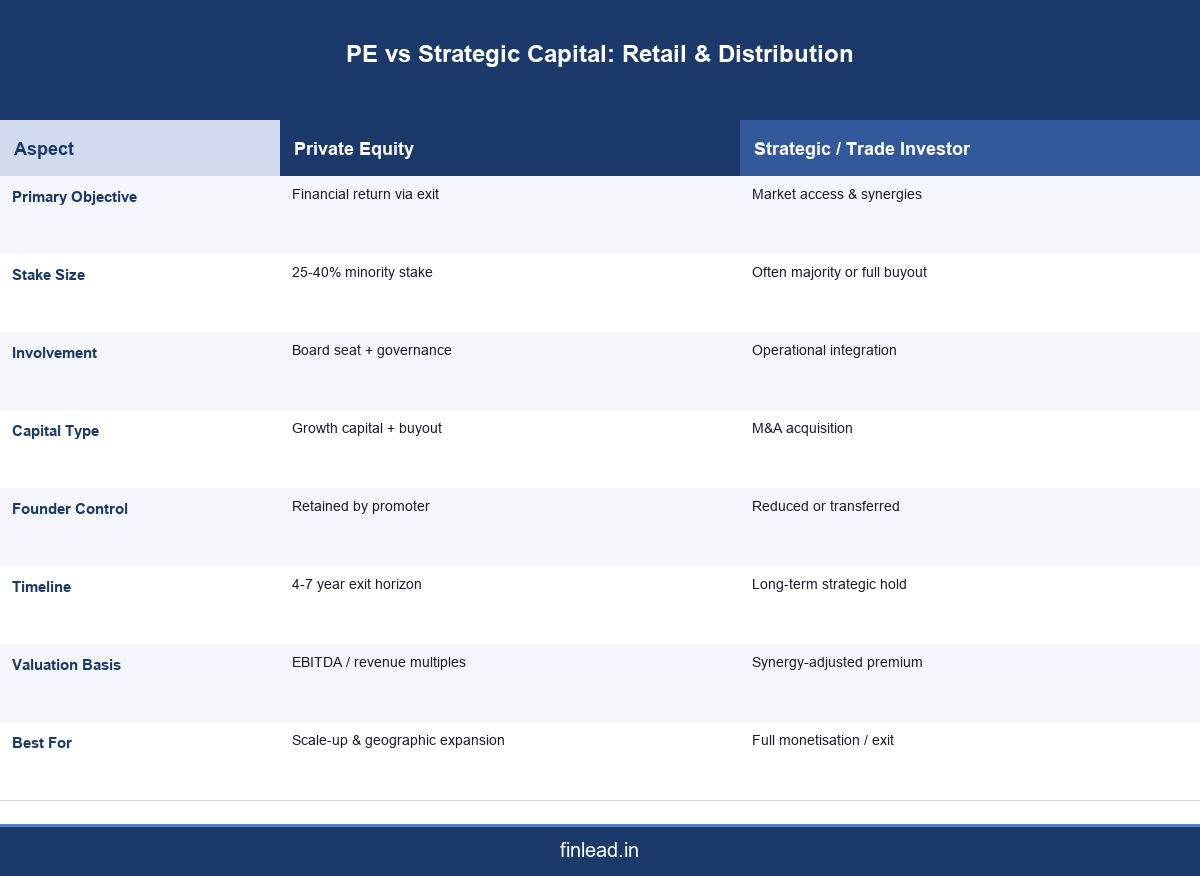
PE vs Strategic Capital: Retail & Distribution
Valuation Approaches for Retail and Distribution PE Deals
Retail businesses are typically valued on an EV/EBITDA basis, with mature profitable chains trading at 10 to 16 times EBITDA depending on growth rate, category attractiveness, and geographic expansion potential. High-growth specialty retailers in attractive categories can command 18 to 22 times EBITDA if the growth trajectory is demonstrably strong and the brand has achieved regional dominance.
Distribution businesses are more commonly valued on a revenue or gross profit multiple basis, given the lower EBITDA margins typical of the sector. Exclusive distributors of premium brands with strong working capital management trade at 6 to 10 times EBITDA. Businesses with thin margins, high working capital, and no exclusivity may be valued at 4 to 6 times, reflecting the capital intensity and competitive risk.
Valuation is heavily influenced by the quality of financial reporting. Many retail and distribution businesses maintain accounts that blend personal and business expenses, include undocumented cash transactions, or have inconsistent inventory valuation methods. Cleaning up financial reporting before investor engagement, ideally with two to three years of audited accounts under Ind AS, significantly reduces the due diligence friction and improves achievable valuation. A fundraising advisory firm can guide this process efficiently.
Structuring a Retail PE Transaction
Most retail PE transactions are structured as primary equity issuances, where new shares are issued to the PE investor in exchange for fresh capital that funds expansion. Secondary transactions, where the founder partially exits, are also possible and allow founders to partially monetise while continuing to grow the business with PE support.
In multi-generational family businesses operating in retail, founders often want to use the PE raise to buy out inactive family shareholders before or concurrent with the investor's entry. This clean-up transaction is common in family-owned retail and distribution businesses and requires careful structuring to ensure the clean-up does not trigger tax events that erode the available funding for business growth.
Governance requirements from PE investors include board representation, information rights, approval thresholds for major decisions, and anti-dilution protections. Understanding these governance norms and negotiating appropriate safeguards before signing a term sheet is essential. An experienced M&A advisory team ensures founders understand the implications of every governance clause before they agree to it.
Preparing Your Retail or Distribution Business for PE Fundraising
The preparation phase is where deals are won or lost. Businesses that arrive at investor meetings with clean financials, a compelling unit economics story, a clear expansion roadmap, and a capable management team close transactions faster and at better valuations than those that are unprepared.
Start by documenting store-level or territory-level P&L for all operating units. PE investors want to see the cohort analysis: how stores or territories opened in Year 1 are performing relative to stores opened in Year 3. This cohort data, when it shows improving unit economics over time, is one of the most persuasive elements of a retail fundraising story.
Build a three-year expansion plan that maps capital deployment against specific store openings or territory additions. The plan should show how investor capital translates into revenue growth and EBITDA expansion. Investors fund businesses with clear capital deployment logic. Vague plans to expand into more regions are insufficient. A plan that shows specific store locations, the capex per store, the expected ramp timeline, and the projected per-store economics is what closes term sheets.
Engage a PE advisory firm at least 12 months before your target fundraising date. This lead time allows for financial clean-up, structural improvements, management team strengthening, and brand documentation, all of which significantly improve the quality of the investor conversation and the speed of transaction execution.
India's retail and distribution sector offers PE investors a rare combination of large market size, low organised penetration, and proven consumer demand. For business owners, PE capital is the most efficient path to scale when organic reinvestment is too slow to capture the available opportunity. The key is preparation: clean financials, proven unit economics, a scalable model, and the right advisory support. Contact FinLead to begin your PE fundraising journey with a confidential advisory assessment.
Frequently Asked Questions
What type of retail businesses attract private equity investment in India?
PE investors back specialty retail chains with proven unit economics, omnichannel formats, and scalable store models. Categories attracting the most capital include pharmacy chains, beauty and personal care, food and beverage, fashion accessories, and home improvement retail with clear geographic expansion potential.
Do distribution businesses qualify for PE investment in India?
Yes. Distributors with exclusive principal relationships, wide geographic coverage, digitised operations, and strong working capital management are attractive PE targets. B2B distribution platforms aggregating multiple brands across categories attract particularly strong investor interest due to their network effects and scalability.
How are retail businesses valued for private equity investment?
Profitable retail chains typically trade at 10 to 16 times EBITDA. High-growth specialty retailers in premium categories can command 18 to 22 times. Valuation depends on unit economics quality, growth rate, category attractiveness, brand strength, and management depth.
What financial metrics do PE investors examine in retail due diligence?
Key metrics include revenue per store, store-level EBITDA, payback period, gross margin, customer acquisition cost, and repeat purchase rate. For distribution, investors focus on revenue per territory, gross margin by category, collection cycle, and working capital efficiency.
How much equity stake does PE typically take in retail businesses?
PE investors typically seek 25 to 40 percent equity in growth-stage retail businesses. This minority stake structure allows founders to retain majority control while accessing growth capital. Buyout structures, where PE takes majority control, are less common in growth-stage retail fundraising.
What governance rights do PE investors require in retail transactions?
PE investors typically require board representation, information rights, approval thresholds for major financial decisions, and anti-dilution protections. These provisions are negotiable and should be reviewed carefully with M&A advisory support before agreeing to a term sheet.
How long does a retail PE fundraising process take in India?
The end-to-end process from advisory engagement to transaction close typically takes 10 to 14 months. Financial clean-up and structural improvements can add 3 to 6 months if begun as part of the process. Starting preparation early significantly reduces the total timeline.
How can a family-owned retail business prepare for PE investment?
Key steps include separating personal and business finances, obtaining audited accounts for two to three years, documenting unit economics, and resolving any inactive family shareholding through a pre-transaction clean-up. FinLead's advisory team can guide this process from start to finish.
What is the difference between PE and strategic investment for retail businesses?
PE investors seek financial returns via a defined exit and typically take a minority stake with a 4 to 7 year horizon. Strategic investors seek operational synergies and often pursue majority or full acquisition. PE is better suited for founders seeking growth capital while retaining control.
What role does technology play in retail PE fundraising?
Technology adoption, including distribution management systems, real-time inventory tracking, and digital sales channels, is increasingly a due diligence criterion. Businesses with strong technology infrastructure are seen as lower execution risk, which translates into faster deal timelines and better valuations.