Private Equity for Education Institutions in India: What PE Investors Look For
Private Equity for Education Institutions in India | PE Investors

India's education sector is one of the largest and fastest-growing in the world. With over 250 million students enrolled across schools, colleges, vocational institutes, and digital platforms, private equity education India has emerged as a significant capital allocation theme. PE investors have deployed billions of dollars into K-12 chains, higher education groups, test-preparation companies, and edtech platforms over the past decade.
Yet most education institution owners remain unclear about what separates a fundable business from one that investors pass on. This guide explains exactly what PE investors look for, how to structure your institution for fundraising, and what steps to take before approaching investors.
Key Takeaways
- PE investors in education prioritize scalability, compliance, and consistent student enrollment growth above all else.
- Institutions with replicable models, digital integration, and strong faculty retention attract significantly higher valuations.
- Engaging a PE advisory firmearly helps align your structure, financials, and governance with investor expectations.
Why PE Investors Are Interested in India's Education Sector
India's education market is projected to reach USD 225 billion by 2025, driven by rising aspirations, a young demographic, and increasing household spending on quality education. PE investors are drawn to education for several reasons: recurring revenue from annual fee cycles, low customer churn once enrolled, brand loyalty in successful institutions, and a clear path to multi-location scaling.
The sector also benefits from structural demand. India produces more graduates than any country except China, yet quality education remains scarce. Institutions that solve quality and access gaps at scale attract premium investor interest. Private equity in Indian education has backed names like Manipal Education, K12 Techno Services, Byju's, Unacademy, and several K-12 chain operators, reflecting the depth of capital deployment opportunities.
For PE investors, education offers something rare: a defensible niche where brand and reputation create natural barriers to competition. A school with a 15-year track record, a waiting list, and a consistent board result cannot be replicated overnight. This defensibility, combined with scalable operating models, makes education a compelling PE investment thesis.
Types of Education Businesses That Attract PE Capital
Not all education businesses attract the same investor attention. PE capital in this sector flows toward a defined set of business types. K-12 school chains with multiple campuses and a centralized curriculum model are among the most sought-after. Investors value the predictability of annual fee revenue, the ability to add campuses under the same brand, and the demonstrated ability to maintain quality across locations.
Test preparation and coaching chains, particularly in competitive exam segments such as IIT-JEE, NEET, UPSC, and CAT, attract investors because of high ARPU, short enrollment cycles, and proven demand. Vocational training institutes aligned with government skilling programs or industry-specific certifications are also fundable, especially when they show placement rates and employer partnerships.
Higher education institutions, including private universities and deemed universities, represent the largest PE deals in the sector. Investors are drawn to degree-granting authority, long enrollment tenures, and strong alumni networks. Edtech companies with proprietary content, learning management systems, and measurable student outcomes have attracted significant venture and growth PE capital. Institutions combining offline scale with online delivery create the most compelling scalability story in 2024 and beyond.
What PE Investors Specifically Evaluate
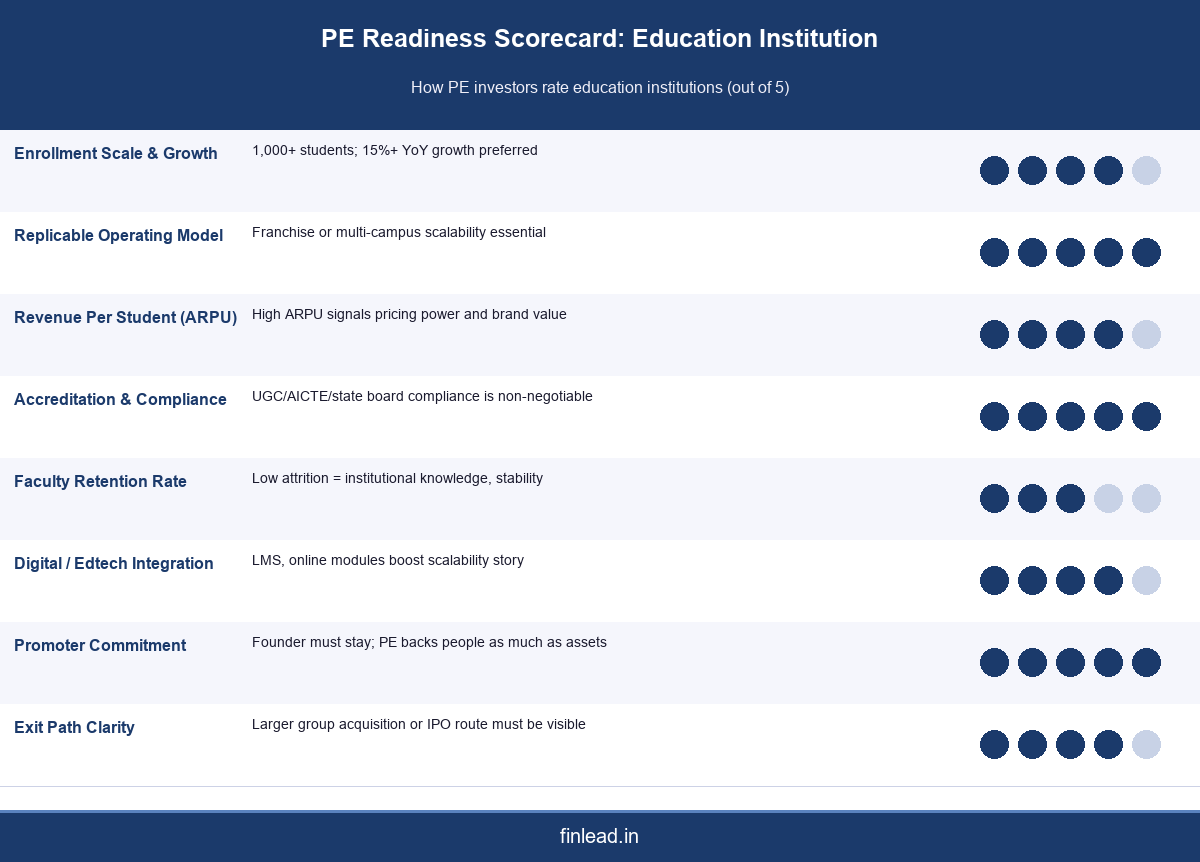
When a PE fund evaluates an education institution, due diligence goes far beyond financial statements. Enrollment trajectory is the most critical operational metric. Investors want to see consistent growth in student numbers over three to five years, ideally 15 percent or more annually. Declining enrollment, even at a profitable institution, signals demand risk and makes fundraising difficult.
Revenue per student, or ARPU, reflects pricing power and brand positioning. An institution charging double the market rate with a full waitlist has proved its value proposition. Investors calculate total addressable enrollment, current penetration, and the gap that capital deployment can close. They also examine fee collection efficiency and bad debt ratios, which reveal operational discipline.
Faculty quality and retention are evaluated seriously. High faculty attrition indicates weak institutional culture, poor pay structures, or management dysfunction, all of which translate into operational risk for investors. Institutions that have built structured faculty development programs, competitive pay, and clear career tracks score significantly higher in due diligence.
Regulatory and compliance status is non-negotiable. Institutions must hold valid recognition from UGC, AICTE, state education boards, or relevant regulatory authorities. Any compliance gaps, pending renewals, or litigation involving regulatory bodies can block a transaction entirely. PE investors will not close a deal with unresolved regulatory exposure. Engaging a fundraising advisory firm early ensures compliance gaps are identified and addressed before investor conversations begin.
Scalability and the Multi-Campus Model
The single most important factor for education PE is whether the institution's model is replicable. A single prestigious school with 2,000 students and strong results is admirable but not scalable by itself. What investors want to see is a proven playbook: centralized curriculum, standardized teacher training, uniform assessment systems, and a brand that parents trust enough to pay a premium for at any location.
Institutions that can demonstrate they have opened a second or third campus and maintained quality metrics, enrollment levels, and ARPU comparable to the original are in a strong fundraising position. This evidence of replicability is what justifies a growth-stage PE investment. Investors are essentially funding the fourth, fifth, and sixth campus, and they need proof that the model holds.
Structuring Your Education Business for PE Investment
Education businesses often have complex legal structures involving trusts, societies, and Section 8 companies alongside for-profit entities. PE investors typically invest in for-profit holding companies, operating companies, or special purpose vehicles that hold the management rights, IP, or fee-collection contracts associated with the institution.
If your institution is entirely structured as a trust or society, a restructuring exercise may be required before fundraising. This involves carving out commercial activities into a private limited company or LLP while ensuring the trust retains its regulatory recognitions. This restructuring must be done carefully to avoid triggering regulatory scrutiny or tax liabilities. A PE advisory firm with experience in education transactions can design the right structure for your specific situation.
Financial reporting standards also need upgrading before approaching PE investors. Most education businesses maintain accounts on a cash basis with minimal segmental reporting. PE investors require accrual-based financials, campus-wise P&L statements, fee-collection schedules, and working capital analysis. Getting two to three years of audited financials prepared under Ind AS significantly strengthens your fundraising position and reduces the time spent in due diligence.
Valuation Benchmarks in Education PE
Education businesses are typically valued on an EV/EBITDA or EV/Revenue basis depending on the stage of growth. Mature, profitable school chains with strong enrollment growth trade at 12 to 18 times EBITDA. High-growth edtech platforms with strong user acquisition metrics and revenue growth can attract 4 to 8 times revenue multiples in venture and growth PE rounds.
The key drivers of valuation premium are enrollment growth rate, ARPU growth, brand strength, geographic expansion potential, and management depth. Institutions with proprietary curriculum, patents on content, or exclusive partnerships with international education brands command premium multiples because these create defensible competitive moats.
Dilution is a common concern among education promoters. In most growth-stage transactions, PE investors take a 25 to 40 percent stake, allowing founders to retain majority ownership and operational control. Control provisions, board representation, and exit timelines are negotiated based on investor appetite and growth ambitions. Understanding these deal dynamics before negotiations begin gives founders significant leverage at the table.
Common Mistakes That Derail Education PE Fundraising
The most common mistake education institution owners make is approaching PE investors before their compliance and financial documentation is in order. Investors will not advance a deal where regulatory approvals are expired, where financial statements are unaudited, or where related-party transactions are unexplained. These gaps create legal risk that no PE fund will absorb.
A second frequent mistake is conflating the trust or charitable structure with the investable entity. Founders who have not separated the management company from the institution often spend months in restructuring discussions before any real due diligence begins. Resolving structural issues upfront, before the first investor meeting, reduces transaction timelines significantly.
Unrealistic valuation expectations are another deal-breaker. Education founders often anchor on publicly listed education companies trading at premium multiples, without accounting for liquidity discounts, minority stake pricing, and the execution risk premium that private transactions carry. Working with an experienced M&A advisory team helps founders calibrate valuation expectations against real market benchmarks, improving negotiation outcomes.
How FinLead Supports Education Sector Fundraising
FinLead has worked with education businesses across K-12, higher education, vocational training, and edtech segments to structure and close PE transactions. Our work begins well before the first investor meeting. We assess the institution's operational metrics, identify structural and compliance gaps, and build a financial model that accurately reflects the growth opportunity.
We prepare a detailed information memorandum that speaks the language of PE investors, addressing the questions they will ask before they ask them. Our investor relations team maintains active relationships with domestic and cross-border PE funds that have active education mandates, ensuring your institution reaches the right capital partners. We manage the end-to-end process from investor identification through term sheet negotiation to transaction close.
If you are considering a PE raise for your education business, contact FinLead to begin the conversation with a confidential advisory assessment.
Private equity capital is transforming India's education sector, backing institutions that combine quality, scale, and operational discipline. Founders who understand what investors look for and who prepare their businesses systematically stand a far stronger chance of closing transactions on favorable terms. The right preparation, the right structure, and the right advisory support make the difference between a deal that closes and one that stalls at due diligence. Reach out to FinLead to explore how we can support your institution's PE fundraising journey.
Frequently Asked Questions
What type of education businesses attract PE investment in India?
PE investors in India back K-12 school chains, test-preparation companies, vocational institutes, higher education groups, and edtech platforms. The common thread is a scalable operating model, recurring revenue, and consistent enrollment growth above 15 percent annually.
How much stake do PE investors typically take in education businesses?
PE investors typically take 25 to 40 percent equity in education businesses at the growth stage. This allows founders to retain majority control and operational authority while accessing the capital needed to expand campuses or scale digital offerings.
What financial metrics do education PE investors focus on?
Key metrics include enrollment growth rate, revenue per student, fee collection efficiency, campus-level EBITDA margins, and faculty retention. Investors also examine the gap between current enrollment and total addressable capacity to assess growth headroom.
Can a trust or society structure raise PE investment in education?
Trusts and societies cannot directly receive PE investment. A for-profit entity, typically a private limited company holding management rights or contracts, must be created. Structuring this carve-out correctly requires M&A advisory expertise to avoid regulatory and tax complications.
What compliance requirements must education institutions meet before fundraising?
Institutions must have valid recognition from UGC, AICTE, or state education boards. All fee structures, land-use permissions, and trust deed provisions must be compliant. Any pending litigation with regulatory authorities must be disclosed and ideally resolved before investor engagement begins.
How are education businesses valued for PE investment?
Mature profitable education businesses are valued at 12 to 18 times EBITDA. High-growth edtech platforms may attract 4 to 8 times revenue multiples. Valuation drivers include enrollment growth, ARPU, geographic expansion potential, brand strength, and management team depth.
What is the typical timeline for an education PE transaction in India?
From initial advisory engagement to transaction close, education PE deals typically take 9 to 15 months. Structuring and compliance remediation can add 3 to 6 months if undertaken as part of the process. Preparation before engagement significantly shortens the timeline.
How does FinLead support education businesses seeking PE investment?
FinLead assesses operational readiness, resolves structural and compliance gaps, builds investor-grade financial models, prepares information memorandums, and manages investor outreach. We maintain active relationships with domestic and international PE funds that have education sector mandates. Learn more here.
What exit options do PE investors expect from education investments?
PE investors in education expect exits through strategic acquisition by a larger education group, secondary sales to other PE funds, or an initial public offering. Institutions with multi-campus scale and a nationally recognised brand are best positioned for premium exits.
How important is digital integration for education PE fundraising?
Digital integration significantly strengthens the fundraising case. Institutions with learning management systems, online assessment tools, or hybrid delivery models demonstrate higher scalability and lower marginal cost per student, which PE investors view as indicators of superior unit economics.